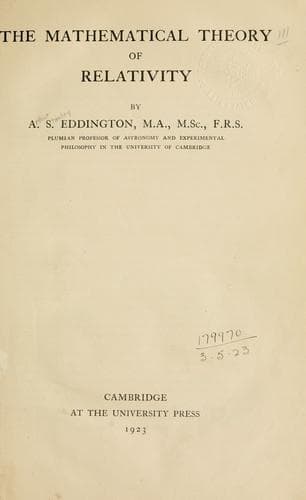
The Mathematical Theory of RelativityEddington, Arthur Stanley, Sir
Science
The Mathematical Theory of Relativity
Eddington, Arthur Stanley, Sir
Relativity (Physics)
There is no special rule for representing physical quantities such as electric
force, potential, temperature, etc.; we may draw the isotherms as straight
lines, ellipses, spheres, according to convenience of illustration. But there are
certain physical quantities (i.e.\ results of operations and calculations) which
have a natural graphical representation; we habitually think of them graphically,
and are almost unconscious that there is anything conventional in the
way we represent them. For example, measured distances and directions are
instinctively conceived by us graphically; and the space in which we represent
them is for us \emph{actual space}. These quantities are not in their intrinsic
nature dissimilar from other physical quantities which are not habitually represented
geometrically. If we eliminated the human element (or should we not
say, the pre-human element?)\ in natural knowledge the device of graphical
representation of the results of measures or estimates of distance would appear
just as artificial as the graphical representation of thermometer readings. We
cannot predict that a superhuman intelligence would conceive of distance in
the way we conceive it; he would perhaps admit that our device of mentally
\PageSep{197}
plotting the results of a survey in a three-dimensional space is ingenious and
scientifically helpful, but it would not occur to him that this space was more
\emph{actual} than the $pv$~space of an indicator-diagram.
In our previous work we have studied this unsophisticated graphical representation
of certain physical quantities, under the name Natural Geometry;
we have slightly extended the idea by the addition of a fourth dimension to
include time; and we have found that not only the quantities ordinarily
regarded as geometrical but also mechanical quantities, such as force, density,
energy, are fully represented in this natural geometry. For example the energy-tensor
was found to be made up of the Gaussian curvatures of sections of actual
space-time~\Eq{(65.72)}. But the electromagnetic quantities introduced in the preceding
chapter have not as yet been graphically represented; the vector~$\kappa_{\mu}$ was
supposed to exist \emph{in} actual space, not to be the measure of any property \emph{of} actual
space. Thus up to the present the geometrisation of physics is not complete.
Public-domain text, read in full here on John Shaqi.
Reviews
Reviews
No reviews yet
Be the first to share your thoughts on this work.
Elsewhere in the archive
Join the Discussion
Join the discussion
Sign in to leave a comment or review.
Sign InorCreate an account