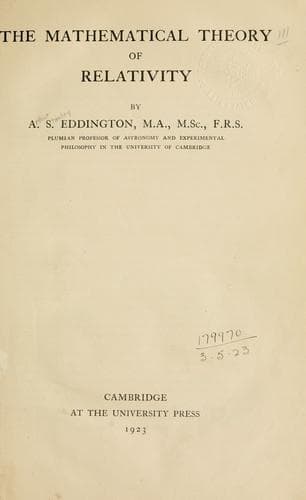
The Mathematical Theory of RelativityEddington, Arthur Stanley, Sir
Science
The Mathematical Theory of Relativity
Eddington, Arthur Stanley, Sir
Relativity (Physics)
The macroscopic method is introduced for practical purposes rather than
as a contribution to the theory, and there seems to be no advantage in developing
it further here. The chief theoretical interest lies in the suggestion
of a possible generalisation of Maxwell's theory by admitting that the covariant
and contravariant electromagnetic tensors may in certain circumstances be
independent tensors, e.g.\ inside the electron. This is the basis of a theory of
matter developed by G.~Mie.
\PageSep{196}
\Chapter{VII}{World Geometry}
\Part{I.}{Weyl's Theory}
\Section{83.}{Natural geometry and world geometry}
\index{Natural coordinates!geometry}%
Graphical representation is a device commonly employed in dealing with
\index{Graphical representation}%
all kinds of physical quantities. It is most often used when we wish to set
before ourselves a mass of information in such a way that the eye can take it
in at a glance; but this is not the only use. We do not always draw the graphs
on a sheet of paper; the method is also serviceable when the representation
is in a conceptual mathematical space of any number of dimensions and possibly
non-Euclidean geometry. One great advantage is that when the graphical
representation has been made, an extensive geometrical nomenclature becomes
available for description---straight line, gradient, curvature, etc.---and a self-explanatory
nomenclature is a considerable aid in discussing an abstruse
subject.
It is therefore reasonable to seek enlightenment by giving a graphical
representation to all the physical quantities with which we have to deal. In
this way physics becomes geometrised. But graphical representation does not
assume any hypothesis as to the ultimate nature of the quantities represented.
The possibility of exhibiting the whole world of physics in a unified geometrical
representation is a test not of the nature of the world but of the ingenuity of
the mathematician.
Public-domain text, read in full here on John Shaqi.
Reviews
Reviews
No reviews yet
Be the first to share your thoughts on this work.
Elsewhere in the archive
Join the Discussion
Join the discussion
Sign in to leave a comment or review.
Sign InorCreate an account