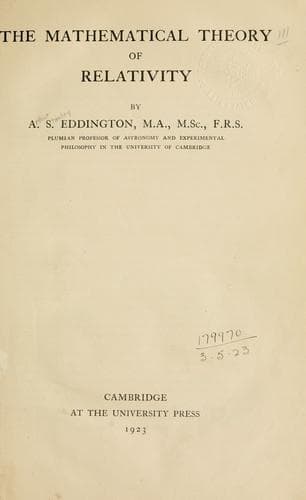
The Mathematical Theory of RelativityEddington, Arthur Stanley, Sir
Science
The Mathematical Theory of Relativity
Eddington, Arthur Stanley, Sir
Relativity (Physics)
The first restriction is not imperatively demanded, and we shall discard it
in Part~II of this chapter. It has the following effect. Equation~\Eq{(84.3)} becomes
\begin{align*}
\delta(l^{2}) &= F_{\nu\sigma} · g_{\mu\epsilon} A^{\mu} A^{\epsilon} · dS^{\nu\sigma} \\
&= F_{\nu\sigma} l^{2}\, dS^{\nu\sigma},
\intertext{so that}
\frac{\delta l}{l} &= \tfrac{1}{2} F_{\nu\sigma}\, dS^{\nu\sigma}.
\Tag{(84.4)}
\end{align*}
The change of length is proportional to the original length and is independent
of the direction of the vector; whereas in the more general formula~\Eq{(84.3)} the
change of length depends on the direction.
One result of the restriction is that zero-length is still zero-length after
parallel displacement round a circuit. If we have identified zero-length at one
point of the world we can transfer it without ambiguity to every other point
and so identify zero-length everywhere. Finite lengths cannot be transferred
without ambiguity; a route of parallel displacement must be specified.
Zero-length is of great importance in optical phenomena, because in
\index{Zero-length of light tracks}%
Einstein's geometry any element of the track of a light-pulse is a vector of
zero-length; so that if there were no definite zero-length a pulse of light would
not know what track it ought to take. It is because Weyl's theory makes no
attempt to re-interpret this part of Einstein's theory that an absolute zero-length
is required, and the restriction~\Item{(a)} is therefore imposed.
Another result of the restriction is that lengths at the same point but in
different orientations become comparable without ambiguity. The ambiguity
is limited to the comparison of lengths at different places.
\PageSep{200}
\Section{85.}{Transformation of gauge-systems}
According to the foregoing section it is not possible to compare lengths
(except zero-length) at different places, because the result of the comparison
will depend on the route taken in bringing the two lengths into juxtaposition.
In Riemannian geometry we have taken for granted this possibility of
comparing lengths. The interval at any point has been assigned a definite
value, which implies comparison with a standard; it did not occur to us to
question how this comparison at a distance could be made. We have now to
define the geometry of the continuum in a way which recognises this difficulty.
We suppose that a definite but arbitrary \emph{gauge-system} has been adopted;
\index{Gauge-system}%
that is to say, at every point of space-time a standard of interval-length has
been set up, and every interval is expressed in terms of the standard at the
point where it is. This avoids the ambiguity involved in transferring intervals
from one point to another to compare with a single standard.
Public-domain text, read in full here on John Shaqi.
Reviews
Reviews
No reviews yet
Be the first to share your thoughts on this work.
Elsewhere in the archive
Join the Discussion
Join the discussion
Sign in to leave a comment or review.
Sign InorCreate an account