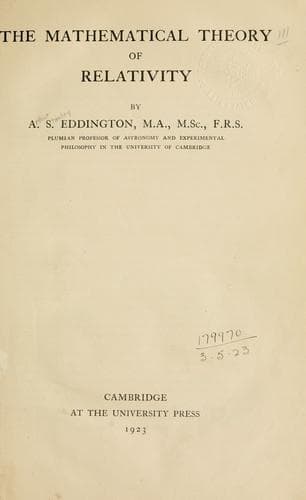
The Mathematical Theory of RelativityEddington, Arthur Stanley, Sir
Science
The Mathematical Theory of Relativity
Eddington, Arthur Stanley, Sir
Relativity (Physics)
Take a displacement at~$P$ (coordinates,~$x_{\mu}$) and transfer it by parallel displacement
to an infinitely near point~$P'$ (coordinates, $x_{\mu} + dx_{\mu}$). Let its initial
length measured by the gauge at~$P$ be~$l$, and its final length measured by the
gauge at~$P'$ be~$l + dl$. We may express the change of length by the formula
\[
d(\log l) = \kappa_{\mu}\, dx_{\mu},
\Tag{(85.1)}
\]
where $\kappa_{\mu}$~represents some vector-field. If we alter the gauge-system we shall,
of course, obtain different values of~$l$, and therefore of~$\kappa_{\mu}$.
It is not necessary to specify the route of transfer for the small distance
$P$ to~$P'$. The difference in the results obtained by taking different routes is
by~\Eq{(84.4)} proportional to the area enclosed by the routes, and is thus of the
second order in~$dx_{\mu}$. As $PP'$~is taken infinitely small this ambiguity becomes
negligible compared with the first-order expression~$\kappa_{\mu}\, dx_{\mu}$.
Our system of reference can now be varied in two ways---by change of
coordinates and by change of gauge-system. The behaviour of~$g_{\mu\nu}$ and~$\kappa_{\mu}$ for
transformation of coordinates has been fully studied; we have to examine how
they will be transformed by a transformation of gauge.
A new gauge-system will be obtained by altering the length of the standard
at each point in the ratio~$\lambda$, where $\lambda$~is an arbitrary function of the coordinates.
If the standard is decreased in the ratio~$\lambda$, the length of a displacement will
be increased in the ratio~$\lambda$. If accents refer to the new system
\[
ds' = \lambda\, ds.
\Tag{(85.2)}
\]
The components $dx_{\mu}$ of a displacement will not be changed, since we are not
altering the coordinate-system, thus
\[
dx_{\mu} = dx_{\mu}'.
\Tag{(85.3)}
\]
Hence
\[
g_{\mu\nu}'\, dx_{\mu}'\, dx_{\nu}'
= ds'^{2}
= \lambda^{2}\, ds^{2}
= \lambda^{2} g_{\mu\nu}\, dx_{\mu}\, dx_{\nu}
= \lambda^{2} g_{\mu\nu}\, dx_{\mu}'\, dx_{\nu}',
\]
so that
\[
g_{\mu\nu}' = \lambda^{2} g_{\mu\nu}.
\Tag{(85.41)}
\]
%\PageSep{201}
It follows at once that
\index{Potential!electromagnetic}%
\begin{align*}
g' & = \lambda^{8} g,
\Tag{(85.42)} \\
{g'}^{\mu\nu} &= \lambda^{-2} g^{\mu\nu},
\Tag{(85.43)} \\
\sqrt{-g'} · d\tau' &= \lambda^{4} \sqrt{-g} · d\tau.
\Tag{(85.44)}
\end{align*}
Again, by~\Eq{(85.1)}
\begin{align*}
\kappa_{\mu}'\, dx_{\mu}
&= d(\log l') = d\{\log(\lambda l)\} \\
&= d(\log l) + d(\log\lambda) \\
&= \kappa_{\mu}\, dx_{\mu} + \frac{\dd(\log\lambda)}{\dd x_{\mu}}\, dx_{\mu}.
\end{align*}
Or, writing
\[
\phi = \log\lambda,
\Tag{(85.51)}
\]
then
\[
\kappa_{\mu}' = \kappa_{\mu} + \frac{\dd\phi}{\dd x_{\mu}}.
\Tag{(85.52)}
\]
Public-domain text, read in full here on John Shaqi.
Reviews
Reviews
No reviews yet
Be the first to share your thoughts on this work.
Elsewhere in the archive
Join the Discussion
Join the discussion
Sign in to leave a comment or review.
Sign InorCreate an account