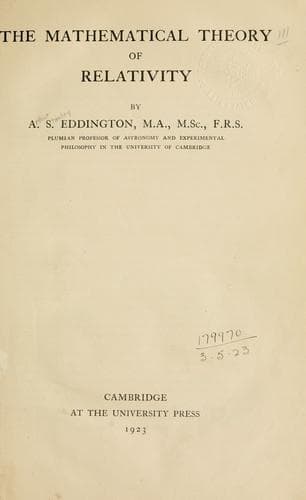
The Mathematical Theory of RelativityEddington, Arthur Stanley, Sir
Science
The Mathematical Theory of Relativity
Eddington, Arthur Stanley, Sir
Relativity (Physics)
Just as we have generalised the equations of physics originally found for
Galilean coordinates, so we could generalise the equations for the natural
gauge by substituting the corresponding in-tensor equations applicable to
any gauge. But before doing so, we stop to ask whether anything would be
gained by this generalisation. There is not much object in generalising the
Galilean formulae, so long as Galilean coordinates are available; we required
the general formulae because we discovered that there are regions of the
world where no Galilean coordinates exist. Similarly we shall only need the
in-tensor equations of mechanics if there are regions where no natural
gauge exists; that is to say, if no gauge-system can be found for which
\PageSep{207}
Einstein's formulae are accurately true. It was, I think, the original idea of
Weyl's theory that electromagnetic fields were such regions, where accordingly
in-tensor equations would be essential.
There is in any case a significant difference between Einstein's generalisation
of Galilean geometry and Weyl's generalisation of Riemannian
geometry. We have proved directly that the condition which renders Galilean
coordinates impossible \emph{must} manifest itself to us as a gravitational field of
force. That is the meaning of a field of force according to the definition of force.
But we cannot prove that the break-down of the natural gauge would manifest
itself as an electromagnetic field; we have merely speculated that the world-condition
measured by the vector~$\kappa_{\mu}$ which appears in the in-tensor equations
may be the origin of electrical manifestations \emph{in addition} to causing the
failure of Riemannian geometry.
Public-domain text, read in full here on John Shaqi.
Reviews
Reviews
No reviews yet
Be the first to share your thoughts on this work.
Elsewhere in the archive
Join the Discussion
Join the discussion
Sign in to leave a comment or review.
Sign InorCreate an account