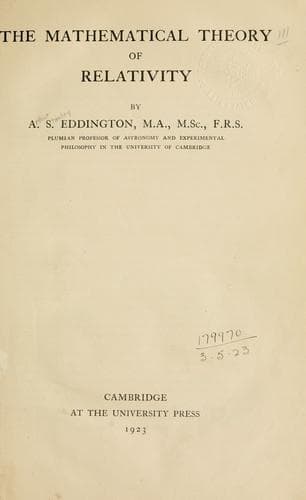
The Mathematical Theory of RelativityEddington, Arthur Stanley, Sir
Science
The Mathematical Theory of Relativity
Eddington, Arthur Stanley, Sir
Relativity (Physics)
Accepting the original view of Weyl's theory, the ambiguity in the
comparison of lengths at a distance has hitherto only shown itself in practical
experiments by the electromagnetic phenomena supposed to be dependent on
it but not (so far as we can see) immediately implied by it. This is not
surprising when we attempt to estimate the order of magnitude of the
ambiguity. Taking formula~\Eq{(84.4)}, $dl/l = \frac{1}{2} F_{\nu\sigma}\, dS^{\nu\sigma}$, we might perhaps expect
that $dl/l$~would be comparable with unity, if the electromagnetic force~$F_{\nu\sigma}$
were comparable with that at the surface of an electron, $4 · 10^{18}$~volts per~cm.,
and the side of the circuit were comparable with the radius of curvature of
space. Thus for ordinary experiments $dl/l$~would be far below the limits of
experimental detection. Accordingly we can have a gauge-system specified
by the transfer of material standards which is for all practical purposes
unambiguous, and yet contains that minute theoretical ambiguity which is
only of practical consequence on account of its side-manifestation as the
cause of electrical phenomena. The gauge-system employed in practice is
the natural gauge-system to which our previous mechanical formulae apply---or
rather, since the practical gauge-system is slightly ambiguous and the
theoretical formulae are presumably exact, the natural gauge is an exact
gauge with which all practical gauges agree to an approximation sufficient
for all observable mechanical and metrical phenomena.
According to Weyl the natural gauge is determined by the condition
\[
\Star{G} = 4\lambda,
\Tag{(89.1)}
\]
where $\lambda$~is a constant everywhere.
This attempt to reconcile a theoretical ambiguity of our system of
measurement with its well-known practical efficiency seems to be tenable,
though perhaps a little overstrained. But an alternative view is possible.
This states that---
\emph{Comparison of lengths at different places is an unambiguous procedure
having nothing to do with parallel displacement of a vector.}
\PageSep{208}
The practical operation of transferring a measuring-scale from one place
to another is not to be confounded with the transfer by parallel displacement
of the vector representing the displacement between its two extremities. If
this is correct Einstein's Riemannian geometry, in which each interval has
a unique length, must be accepted as exact; the ambiguity of transfer by
parallel displacement does not affect his work. No attempt is to be made to
apply Weyl's geometry as a Natural Geometry; it refers to a different
subject of discussion.
Public-domain text, read in full here on John Shaqi.
Reviews
Reviews
No reviews yet
Be the first to share your thoughts on this work.
Elsewhere in the archive
Join the Discussion
Join the discussion
Sign in to leave a comment or review.
Sign InorCreate an account