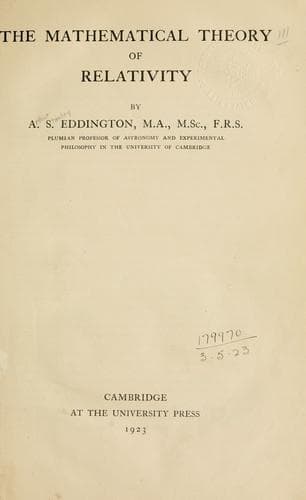
The Mathematical Theory of RelativityEddington, Arthur Stanley, Sir
Science
The Mathematical Theory of Relativity
Eddington, Arthur Stanley, Sir
Relativity (Physics)
Prof.\ Weyl himself has come to prefer the second alternative. He draws a
\index{Adjustment and persistence}%
\index{Persistence and adjustment}%
useful distinction between magnitudes which are determined by \emph{persistence}
(\Foreign{Beharrung}) and by \emph{adjustment} (\Foreign{Einstellung}); and concludes that the dimensions
of material objects are determined by adjustment. The size of an
electron is determined by adjustment in proportion to the radius of curvature
of the world, and not by persistence of anything in its past history. This is
the view taken in \SecRef{66}, and we have seen that it has great value in affording
an explanation of Einstein's law of gravitation.
The generalised theory of Part~II leads almost inevitably to the second
alternative. The first form of the theory has died rather from inanition
than by direct disproof; it ceases to offer temptation when the problem is
approached from a broader point of view. It now seems an unnecessary
speculation to introduce small ambiguities of length-comparisons too small
to be practically detected, merely to afford the satisfaction of geometrising
the vector~$\kappa_{\mu}$ which has more important manifestations.
The new view entirely alters the status of Weyl's theory. Indeed it is no
\index{Weyl's theory!modified view of}%
longer a hypothesis, but a graphical representation of the facts, and its value
lies in the insight suggested by this graphical representation. We need not
now hesitate for a moment over the identification of the electromagnetic
potential with the geometrical vector~$\kappa_{\mu}$; the geometrical vector is the
potential because that is the way in which we choose to represent the
potential graphically. We take a conceptual space obeying Weyl's geometry
and represent in it the gravitational potential by the $g_{\mu\nu}$~for that space and
the electromagnetic potential by the $\kappa_{\mu}$~for that space. We find that all
other quantities concerned in physics are now represented by more or less
simple geometrical magnitudes in that space, and the whole picture enables
us to grasp in a comprehensive way the relations of physical quantities,
and more particularly those reactions in which both electromagnetic and
mechanical variables are involved. Parallel displacement of a vector in this
space is a definite operation, and may in certain cases have an immediate
physical interpretation; thus when an uncharged particle moves freely in a
geodesic its velocity-vector is carried along by parallel displacement~\Eq{(33.4)};
but when a material measuring-rod is moved the operation is not one of
parallel displacement, and must be described in different geometrical terms,
which have reference to the natural gauging-equation~\Eq{(89.1)}.
\PageSep{209}
Public-domain text, read in full here on John Shaqi.
Reviews
Reviews
No reviews yet
Be the first to share your thoughts on this work.
Elsewhere in the archive
Join the Discussion
Join the discussion
Sign in to leave a comment or review.
Sign InorCreate an account