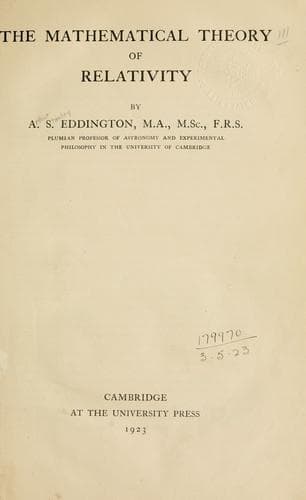
The Mathematical Theory of RelativityEddington, Arthur Stanley, Sir
Science
The Mathematical Theory of Relativity
Eddington, Arthur Stanley, Sir
Relativity (Physics)
Weyl adopts an action-density
\[
A \sqrt{-g} = (\Star{G}^{2} - \alpha F_{\mu\nu} F^{\mu\nu}) \sqrt{-g},
\Tag{(90.1)}
\]
the constant~$\alpha$ being a pure number. He makes the hypothesis that it obeys
\PageSep{210}
the principle of stationary action for all variations $\delta g_{\mu\nu}$, $\delta\kappa_{\mu}$ which vanish at
the boundary of the region considered. Accordingly
\[
\frac{\Ham A}{\Ham g_{\mu\nu}} = 0,\quad
\frac{\Ham A}{\Ham \kappa_{\mu}} = 0.
\Tag{(90.2)}
\]
Weyl himself states that his action-principle is probably not realised in
nature exactly in this form. But the procedure is instructive as showing the
kind of unifying principle which is aimed at according to one school of
thought.
The variation of $\Star{G}^{2} \sqrt{-g}$ is
\[
2\, \Star{G}\, \delta(\Star{G} \sqrt{-g}) - \Star{G}^{2}\, \delta(\sqrt{-g}),
\]
which in the natural gauge becomes by~\Eq{(89.1)}
\[
8\lambda\, \delta(\Star{G} \sqrt{-g}) - 16\lambda^{2}\, \delta(\sqrt{-g}).
\]
Hence by~\Eq{(87.6)}
\[
\frac{1}{8\lambda}\, \delta(A \sqrt{-g})
= \delta \bigl\{(G - 6\kappa_{\alpha}^{\alpha} + 6\kappa_{\alpha} \kappa^{\alpha} - 2\lambda - \beta F_{\mu\nu} F^{\mu\nu}) \sqrt{-g}\bigr\},
\Tag{(90.3)}
\]
where $\beta = \alpha/8\lambda$.
The term $\kappa_{\alpha}^{\alpha} \sqrt{-g}$ can be dropped, because by~\Eq{(51.11)}
\[
\kappa_{\alpha}^{\alpha} \sqrt{-g}
= \frac{\dd}{\dd x_{\alpha}} (\kappa^{\alpha} \sqrt{-g}).
\]
This can be integrated, and yields a surface-integral over the boundary of the
region considered. Its Hamiltonian derivatives accordingly vanish.
Public-domain text, read in full here on John Shaqi.
Reviews
Reviews
No reviews yet
Be the first to share your thoughts on this work.
Elsewhere in the archive
Join the Discussion
Join the discussion
Sign in to leave a comment or review.
Sign InorCreate an account