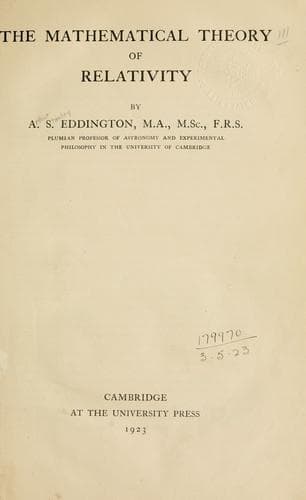
The Mathematical Theory of RelativityEddington, Arthur Stanley, Sir
Science
The Mathematical Theory of Relativity
Eddington, Arthur Stanley, Sir
Relativity (Physics)
For an isolated electron at rest in Galilean coordinates $\kappa_{4} = e/r$, so that
$\kappa_{\alpha} \kappa^{\alpha} = e^{2}/r^{2}$. On integrating throughout infinite space the result is apparently
\PageSep{212}
infinite; but taking account of the finite radius of space, the result is of order~$e^{2}R$.
By~\Eq{(90.62)} this represents the part of the (negative) mass of the electron\footnote
{This must not be confused with mass of the energy of the electromagnetic field. The present
discussion relates to \emph{invariant mass} to which the field contributes nothing.}
which is not concentrated within the nucleus. The actual mass was found in
\SecRef{80} to be of order~$e^{2}/a$ where $a$~is the radius of the nucleus. The two masses
$e^{2}R$ and~$e^{2}/a$ are not immediately comparable since they are expressed in
different units, the connection being made by Weyl's constant~$\beta$ whose value
is left undecided. But since they differ in dimensions of length, they would
presumably become comparable if the natural unit of length were adopted,
viz.\ the radius of the world; in that case $e^{2}/a$~is at least $10^{36}$~times $e^{2}R$, so that
the portion of the mass outside the nucleus is quite insignificant.
The action-principle here followed out is obviously speculative. Whether
the results are such as to encourage belief in this or some similar law, or whether
they tend to dispose of it by something like a \Foreign{reductio ad absurdum}, I will
leave to the judgment of the reader. There are, however, two points which
seem to call for special notice---
(1) When we compare the forms of the two principal energy-tensors
\begin{align*}
T_{\mu}^{\nu} &= -\frac{1}{8\pi} \bigl\{G_{\mu}^{\nu} - \tfrac{1}{2} g_{\mu}^{\nu} (G - 2\lambda)\bigr\}, \\
E_{\mu}^{\nu} &= -F_{\mu\sigma} F^{\nu\sigma} + \tfrac{1}{4} g_{\mu}^{\nu} F_{\alpha\beta} F^{\alpha\beta},
\end{align*}
it is rather a mystery how the second can be contained in the first, since they
seem to be anything but homologous. The connection is simplified by observing
that the difference between them occurs in $\Ham A/\Ham g_{\mu\nu}$ \Eq{(90.51)} accompanied only
by a term which would presumably be insensible except inside the electrons.
But the connection though reduced to simpler terms is not in any way
explained by Weyl's action-principle. It is obvious that his action as it stands
has no deep significance; it is a mere stringing together of two in-invariants
of different forms. To subtract $F_{\mu\nu}F^{\mu\nu}$ from~$\Star{G}^{2}$ is a fantastic procedure which
has no more theoretical justification than subtracting~$E_{\mu}^{\nu}$ from~$T_{\mu}^{\nu}$. At the
most we can only regard the assumed form of action~$A$ as a step towards some
more natural combination of electromagnetic and gravitational variables.
Public-domain text, read in full here on John Shaqi.
Reviews
Reviews
No reviews yet
Be the first to share your thoughts on this work.
Elsewhere in the archive
Join the Discussion
Join the discussion
Sign in to leave a comment or review.
Sign InorCreate an account