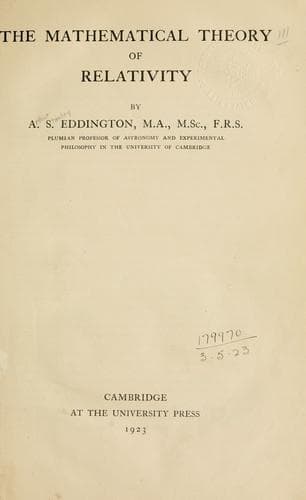
The Mathematical Theory of RelativityEddington, Arthur Stanley, Sir
Science
The Mathematical Theory of Relativity
Eddington, Arthur Stanley, Sir
Relativity (Physics)
(2) For the first term of the action, $\Star{G}^{2} \sqrt{-g}$~was chosen instead of the
simpler $\Star{G} \sqrt{-g}$, \emph{because the latter is not an in-invariant-density} and cannot
be regarded as a measure of any absolute property of the region. It is
interesting to trace how this improvement leads to the appearance of the term
$\delta (-2\lambda \sqrt{-g})$ in~\Eq{(90.3)}, so that the cosmical curvature-term in the expression
for the energy-tensor now appears quite naturally and inevitably. We may
contrast this with the variation of~$G \sqrt{-g}$ worked out in \SecRef{60}, where no such
term appears. In attributing more fundamental importance to the in-invariant
$\Star{G}^{2} \sqrt{-g}$ than to the co-invariant $\Star{G} \sqrt{-g}$, Weyl's theory makes an undoubted
advance towards the truth.
\PageSep{213}
\Part{II.}{Generalised Theory}
\Section{91.}{Parallel displacement}
\index{Displacement!parallel}%
\index{Equivalence of displacements}%
\index{Generalisation of Weyl's theory}%
\index{Parallel displacement}%
Let an infinitesimal displacement~$A^{\mu}$ at the point~$P$ (coordinates,~$x_{\mu}$) be
carried by parallel displacement to a point~$P'$ (coordinates, $x_{\mu} + dx_{\mu}$) infinitely
near to~$P$. The most general possible continuous formula for the change of~$A^{\mu}$
is of the form
\[
dA^{\mu} = -\Gamma_{\nu\alpha}^{\mu} A^{\alpha}\, dx_{\nu},
\Tag{(91.1)}
\]
where $\Gamma_{\nu\alpha}^{\mu}$, which is not assumed to be a tensor, represents $64$~arbitrary
coefficients. Both $A^{\alpha}$ and~$dx_{\nu}$ are infinitesimals, so that there is no need to
insert any terms of higher order.
We are going to build the theory afresh starting from this notion of
infinitesimal parallel displacement; and by so doing we arrive at a generalisation
even wider than that of Weyl. Our fundamental axiom is that parallel
displacement has some significance in regard to the ultimate structure of the
world---it does not much matter what significance. The idea is that out of the
whole group of displacements radiating from~$P'$, we can select one $A^{\mu} + dA^{\mu}$
which has some kind of \emph{equivalence} to the displacement~$A^{\mu}$ at~$P$. We do not
define the nature of this equivalence, except that it shall have reference to the
part played by~$A^{\mu}$ in the relation-structure which underlies the world of physics.
Notice that---
(1) This equivalence is only supposed to exist in the limit when $P$ and~$P'$
are infinitely near together. For more distant points equivalence can in general
only be approximate, and gradually becomes indeterminate as the distance is
increased. It can be made determinate by specifying a particular route of
connection, in which case the equivalence is traced step by step along the
route.
(2) The equivalence is not supposed to exist between any world-relations
other than displacements. Hitherto we have applied parallel displacement to
any tensor, but in this theory we only use it for displacements.
Public-domain text, read in full here on John Shaqi.
Reviews
Reviews
No reviews yet
Be the first to share your thoughts on this work.
Elsewhere in the archive
Join the Discussion
Join the discussion
Sign in to leave a comment or review.
Sign InorCreate an account