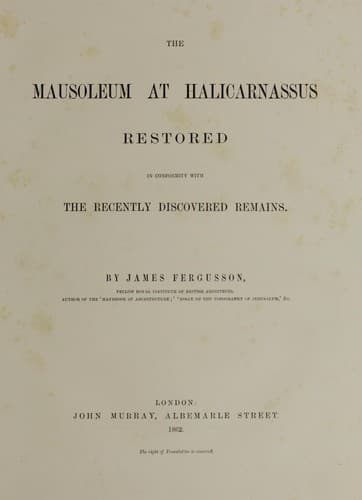
Some forty or fifty of these restorations have been published, and
a strange and amusing collection they are. Some are round, some
octagonal, some cruciform, some oblong or square in plan, some are
squat, some tall.[1] Every dimension found in Pliny was applied to
every part in succession, but in vain. All these designs had only one
thing in common;—that they were all wrong,—some more, some less so, but
none seizing what now turn out to be the main features of the design.
In 1846, Lord Stratford de Redcliffe, who was then all-powerful as our
ambassador at Constantinople, obtained from the Porte a firman for the
removal of certain bassi-rilievi which had been built into the walls
of the Castle of Budrum, the ancient Halicarnassus. These arrived in
England in due course, and were at once admitted to be fragments of
the sculpture of the Mausoleum, as it had been previously assumed that
they were. But their beauty only served further to increase the regret
that all traces of the building to which they once belonged should have
been, as it then appeared, for ever lost.
While things were in this very unsatisfactory position, the public
heard with no small degree of interest that Mr. Charles Newton,
formerly one of the officers of the British Museum, and then
Vice-Consul at Mitylene, had not only discovered the true site of the
Mausoleum on a spot formerly indicated by Professor Donaldson, but had
found considerable remains of the long-lost building.
Public attention was still further attracted to the subject when it
was announced that the British Government had fitted out an extensive
expedition, to continue the explorations commenced by Mr. Newton at
Budrum and its neighbourhood. From the time that the expeditionary
force commenced its labours in October, 1856, till it was broken up
nearly three years afterwards, in June, 1859, occasional paragraphs
kept up the interest in its proceedings, and latterly the arrival
of the marbles themselves excited expectation to the highest pitch.
Everything seemed to shadow forth a most brilliant success; and, from
the high character which Mr. Newton bore as a Greek scholar, and a
thoroughly educated archæologist, all the Hellenist public rejoiced
that an expedition fitted out on so liberal a scale, and for so
desirable an object, had fallen into what all then believed to be such
competent hands.
The first published results were not encouraging. They took the form
of Papers presented to Parliament, and published as a Blue Book in
1858, and a second series entitled “Further Papers relating to the
Excavations at Budrum and Cnidus, presented in August, 1859.”
Public-domain text, read in full here on John Shaqi.
Reviews
Reviews
No reviews yet
Be the first to share your thoughts on this work.
Join the Discussion
Join the discussion
Sign in to leave a comment or review.
Sign InorCreate an account