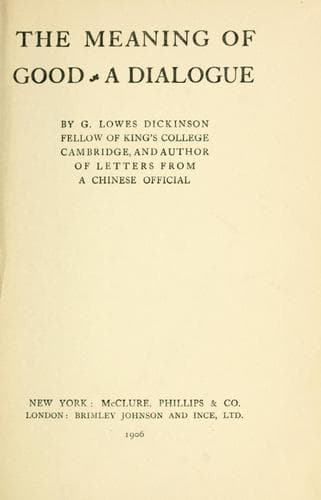
The Meaning of Good—A DialogueDickinson, G. Lowes (Goldsworthy Lowes)
Philosophy
The Meaning of Good—A Dialogue
Dickinson, G. Lowes (Goldsworthy Lowes)
Good and evil
"Oh!" I said, "I know nothing about that. I only know that when we
talk of a person, we don't mean merely his body."
"No," said Ellis, "but we certainly mean also his body. Heaven save
me from a mere naked soul, 'ganz ohne Körper, ganz abstrakt,' as Heine
says."
"But, at any rate," I said, "let me ask you, for the moment, to
consider the soul apart from the body."
"The soul," cried Wilson, "I thought we weren't to talk about body and
soul."
"Well," I said, "I didn't intend to, but I seem to have been driven
into it unawares."
"But what do you mean by the soul?"
"I mean," I replied, "what I suppose to be the proper object of
psychology--for even people who object to the word 'soul' don't mind
talking (in Greek, of course) of the science of the soul. Anyhow, what
I mean is that which thinks and feels and wills."
"Well, but what about it?" said Ellis.
"The first thing about it is that it is, as it seems to me, of all
things the most intelligible."
"I should have said," Wilson objected, "that it was of all things the
least."
"Yes; but we are probably thinking of different things. What you have
in your mind is the connection of this thing which you refuse to call
the soul, with the body, the genesis and relations of its various
faculties, the measurement of its response to stimuli, and all the
other points which are examined in books of psychology. All that
I agree is very unintelligible; I, at least, make no profession of
understanding it. But what I meant was, that looking at persons as we
know them in ordinary life, or as they are shown to us in literature
and art, they really are intelligible to us in the same way that we
are intelligible to ourselves."
"And how is that?"
"Why, through motives and passions. There is, I suppose, no feeling or
action of which human beings are capable, from the very highest to
the very lowest, which other human beings may not sympathetically
understand, through the mere fact that they have the same nature.
They will understand more or less according as they have more or
less sympathy and insight; but in any case they are capable of
understanding, and it is the business of literature and art to make
them understand."
"That is surely a curious use of the word 'understand.'"
"But it is the one, I think, which is important for us. At any rate,
what I mean is that the object presented is so akin, not indeed (as
in the case of ideas) merely to our thought, but to our whole complex
nature, that it does not demand explanation."
"What!" cried Audubon. "Well, all I can say is that most of the people
I, at any rate, come across do most emphatically demand explanation.
I don't see why they're there, or what they're doing, or what they're
for. Their existence Is a perpetual problem to me! And what's worse,
probably my existence is the same to them!"
"But," I said, "surely if you had leisure or inclination to study them
all sympathetically, you would end by understanding them."
Public-domain text, read in full here on John Shaqi.
Reviews
Reviews
No reviews yet
Be the first to share your thoughts on this work.
Elsewhere in the archive
Join the Discussion
Join the discussion
Sign in to leave a comment or review.
Sign InorCreate an account