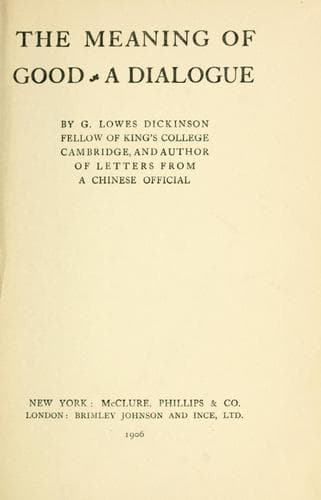
The Meaning of Good—A DialogueDickinson, G. Lowes (Goldsworthy Lowes)
Philosophy
The Meaning of Good—A Dialogue
Dickinson, G. Lowes (Goldsworthy Lowes)
Good and evil
"True; and here we come by a new path upon the defect which we
noticed before in works of art--that their Beauty, or Goodness, is not
essential to their whole nature, but is something imposed, as it were,
on an alien stuff. And it is this alien element that we now pronounce
to be unintelligible."
"Yes; and so, as we agreed before, we cannot pronounce works of art to
be absolutely good."
"No. But what are we to do then? Where are we to turn? Is there
nothing in our experience to suggest the kind of object we seem to
want?"
No one answered. I looked round in vain for any help, and then, in
a kind of despair, moved by I know not what impulse, I made a direct
appeal to Audubon.
"Come!" I cried, "you have said nothing for the last hour! I am sure
you must have something to suggest."
"No," he said, "I haven't. Your whole way of dealing with these things
is a mystery to me. I can't conceive, for example, why you have never
once referred all through to what I should have thought was the best
Good we know--if, indeed, we know any Good at all."
"What do you mean?"
"Why," he said, "one's relations to persons. They're the only things
that I think really worth having--if anything were worth having."
A light suddenly broke on me, and I cried, "Yes! an idea!"
"Well," said Ellis, "what is it, you man of forlorn hopes?"
"Why," I said, "suppose the very object we are in search of should be
found just there?"
"Where?"
"Why, in persons!"
"Persons!" he repeated. "But what persons? Any, every, all?"
"Wait one moment," I cried, "and don't confuse me! Let me approach the
matter properly."
"Very well," he said, "you shan't be hurried! You shall have your
chance."
"Let us remind ourselves, then," I proceeded, "of the point we had
reached. The Good, we agreed, so far as we have been able to form
a conception of it, must be something immediately presented,
and presented in such a way, that it should be directly
intelligible--intelligible not only in the relations that obtain
between its elements, but also in the substance, so to speak, of the
elements themselves. Of such intelligibility we had a type, as Dennis
maintained, in the objects of pure thought, ideas and their relations.
But the Good, we held, could not consist in these. It must be
something, we felt, somehow analogous to sense, and yet it could not
be sense, for sense did not seem to be intelligible. But now, when
Audubon spoke, it occurred to me that perhaps we might find in persons
what we want And that is what I should like to examine now."
"Well," said Ellis, "proceed."
"To begin with, then, a person, I suppose we shall agree, is not
sense, though he is manifested through sense."
"What does that mean?" said Wilson.
"It means only, that a person is not his body, although we know him
through his body."
"If he isn't his body," said Wilson, "he is probably only a function
of it."
Public-domain text, read in full here on John Shaqi.
Reviews
Reviews
No reviews yet
Be the first to share your thoughts on this work.
Elsewhere in the archive
Join the Discussion
Join the discussion
Sign in to leave a comment or review.
Sign InorCreate an account