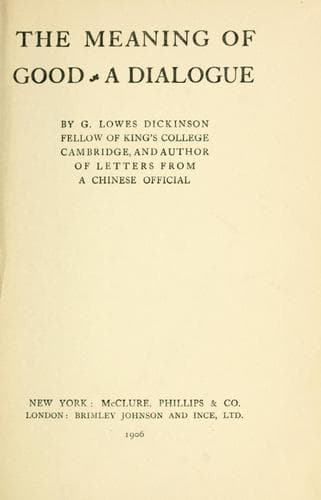
The Meaning of Good—A DialogueDickinson, G. Lowes (Goldsworthy Lowes)
Philosophy
The Meaning of Good—A Dialogue
Dickinson, G. Lowes (Goldsworthy Lowes)
Good and evil
"But," I replied,"_is_ the body alien? Is it not rather an expression
of the person? as essential, somehow or other, as the soul?"
"Certainly!" cried Ellis. "Give me the flesh, the flesh!
"'Not with my soul, Love!--bid no soul like mine
Lap thee around nor leave the poor sense room!
Take sense too--let me love entire and whole--
Not with my soul.'"
"I don't agree with the sentiment of that," said Leslie, "and anyhow,
I don't see how it bears on the question. For the point of the poem
is rather to emphasize than to deny the opposition between body and
soul."
"Yes," replied Ellis, "but also to suggest what you idealists call the
transcending of it."
"Do you mean that in the marriage relation, for example ..."
"Yes, I mean that in that act the flesh, so to speak, is annihilated
at the very moment of its assertion, and what you get is a feeling of
total union with the person, body and soul at once, or rather, neither
one nor the other, but simply that which is in and through both."
"I should have thought," objected Leslie, "it was rather a case of the
soul being merged in the body."
"That depends," replied Ellis.
"Yes," I said, "it depends on many things! But what I was thinking
of was that, quite apart from that experience, and in the moments
of sober observation, one does feel, does one not, a ^correspondence
between body and soul, as though the one were the expression of the
other?"
"I don't know," objected Audubon. "What I feel is much more often a
discrepancy."
"But still," I urged, "even when there appears to be a discrepancy
to begin with, don't you think that in the course of years the spirit
does tend to stamp its own likeness on the flesh, and especially on
the features of the face?"
"'For soul is form,'" quoted Leslie, "'and doth the body make.'"
"Yes," I said, "and that verse, I believe, is not merely a beautiful
fancy of the poet's, but rather as the Greeks maintained--and on such
a point they were good judges--a profound and significant truth.
At any rate, I find it to be so in the case of the people I care
about--though there I know Audubon will dissent. In them, every
change of expression, every tone of voice, every gesture has its
significance; there is nothing that is not expressive--not a curl of
the hair, not a lift of the eyebrows, not a trick of speech or gait.
The body becomes, as it were, transparent and pervious to the soul;
and that inexplicable element of sense, which baffles us everywhere
else, seems here at last to receive its explanation in presenting
itself as the perfect medium of spirit."
"If you come to that," cried Ellis, "you might as well extend your
remarks to the clothes. For they, to a lover's eyes, are often as
expressive and adorable as the body itself."
Public-domain text, read in full here on John Shaqi.
Reviews
Reviews
No reviews yet
Be the first to share your thoughts on this work.
Elsewhere in the archive
Join the Discussion
Join the discussion
Sign in to leave a comment or review.
Sign InorCreate an account