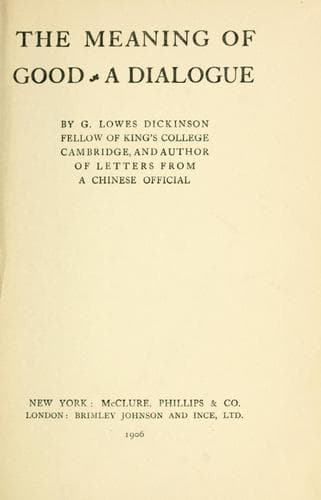
The Meaning of Good—A DialogueDickinson, G. Lowes (Goldsworthy Lowes)
Philosophy
The Meaning of Good—A Dialogue
Dickinson, G. Lowes (Goldsworthy Lowes)
Good and evil
"Well," I said, "the clothes, too, are a sort of image of the soul,
'an imitation of an imitation,' as Plato would say. But, seriously,
don't you agree with me that there is something in the view which
regards the body as the 'word made flesh,' a direct expression of the
person, not a mere stuff in which he Inheres?"
"Yes," he said, "there may be something in it. At any rate, I
understand what you mean."
"And in so far as that is so," I continued, "the body, though it be
a thing of sense, would nevertheless be directly intelligible in the
same way as the soul?"
"Perhaps, in a sort of way."
"And so we should have In the person loved an object which, though
presented to sense, would be at once good and intelligible; and our
activity in relation to this object, the activity, that is, of love,
would come nearer than any other experience of ours to what we might
call a perfect Good?"
"But," objected Leslie, "it is still far enough from being the Good
itself. For after all, say what you may about the body being the
medium of the soul, it is still body, still sense, and, like other
sensible things, subject to change and decay, and in the end to death.
And with the fate of the body, so far as we know, that of the person
is involved. So that this, too, like all other Goods of sense, is
precarious.'
"Perhaps it is," I said, "I cannot tell. But all that I mean to
maintain at present is that in the activity of love, as we have
analysed it, we have something which gives us, if it be only for
a moment, yet still in a real experience, an idea, at least, a
suggestion, to say no more, of what we might mean by a perfect Good,
even though we could not say that it be the Good itself."
"But what, then, would you call the Good itself?"
"A love, I suppose, which in the first place would be eternal, and in
the second all-comprehensive. For there is another defect in love, as
we know it, to which you did not refer, namely, that it is a relation
only to one or two individuals, while outside and beyond it proceeds
the main current of our lives, involving innumerable relations of a
very different kind from this."
"Yes," cried Ellis, "and that is why this gospel of love, with all its
attractiveness, which I admit, seems to me, nevertheless, so trivial
and absurd. Just consider! Here is the great round world with all that
in it is, infinite in time, infinite in space, infinite in complexity;
here is the whole range of human relations, to say nothing of those
that are not human, of activities innumerable in and upon nature and
man himself, of inventions, discoveries, institutions, laws, arts,
sciences, religions; and the meaning and purpose and end of all this
we calmly assert to be--what? A girl and a boy kissing on the village
green!"
"But," I protested, "who said anything about boys and girls and kisses
and village greens?"
"Well, I suppose that is love, of a sort?"
"Yes, of a sort, no doubt; but not a very good one."
Public-domain text, read in full here on John Shaqi.
Reviews
Reviews
No reviews yet
Be the first to share your thoughts on this work.
Elsewhere in the archive
Join the Discussion
Join the discussion
Sign in to leave a comment or review.
Sign InorCreate an account