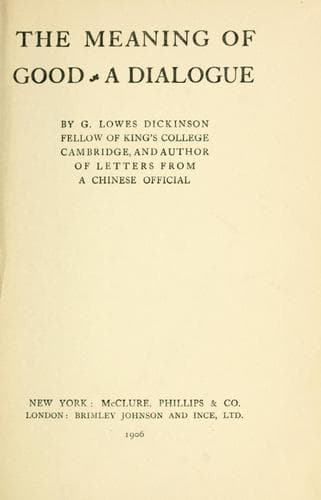
The Meaning of Good—A DialogueDickinson, G. Lowes (Goldsworthy Lowes)
Philosophy
The Meaning of Good—A Dialogue
Dickinson, G. Lowes (Goldsworthy Lowes)
Good and evil
"Why," I replied, "we can surely adopt postulates, as indeed we always
do in practical life. Every man who is about to undertake anything
makes the assumption, in the first place, that it is worth doing, and
In the second place that it is possible to be done. He may be wrong in
both these assumptions, but without them he could not move a step. And
so with regard to the business of life, as a whole, it is necessary
to assume, if we are to make anything of it at all, both that there is
Good, and that we know something about it; and also, I think, that it
is somehow or other realizable; but I do not know that any of these
assumptions could be proved."
"But what right have we, then, to make such assumptions?"
"We have none at all, so far as knowledge is concerned. Indeed, to my
mind, it is necessary, if we are to be honest with ourselves, that we
should never forget that they are assumptions, so long as they have
not received definite proof. But still they are, I think, as I said,
assumptions we are bound to make, if we are to give any meaning to
life. We might perhaps call them 'postulates of the will'; and our
attitude, when we adopt them, that of faith."
"Faith!" protested Wilson, "that is a dangerous word!"
"It is," I agreed. "Yet I doubt whether we can dispense with it.
Only we must remember that to have 'faith' in a proposition is not to
affirm that it is true, but to live as we should do if it were. It
is, in fact, an attitude of the will, not of the understanding; the
attitude of the general going into battle, not of the philosopher in
his closet."
"But," he objected, "where we do not know, the proper attitude is
suspense of mind."
"In many matters, no doubt," I replied, "but surely not in those with
which we are dealing. For we must live or die; and if we are to choose
to do either, we must do so by virtue of some assumption about the
Good."
"But why should we choose to do either? Why should not we simply
wait?"
"But wait how? wait affirming or denying? active or passive? Is it
possible to wait without adopting an attitude? Is not waiting itself
an attitude, an acting on the assumption that it is good to wait?"
"But, at any rate, it does not involve assumptions as large as those
which you are trying to make us accept."
"I am not trying to make you do anything; I am only trying to discover
what you make yourself do. And do you, as a matter of fact, really
dispute the main conclusions to which we have come, or rather, if you
will accept my phrase, the main 'postulates of the will' which we have
elicited?"
"What are they? Let me have them again."
"Well," I said, "here they are. First, that Good has some meaning."
"Agreed!"
"Second, that we know something about that meaning."
"Doubtful!" said Dennis. "But it will be no use now to resume that
controversy."
Public-domain text, read in full here on John Shaqi.
Reviews
Reviews
No reviews yet
Be the first to share your thoughts on this work.
Elsewhere in the archive
Join the Discussion
Join the discussion
Sign in to leave a comment or review.
Sign InorCreate an account