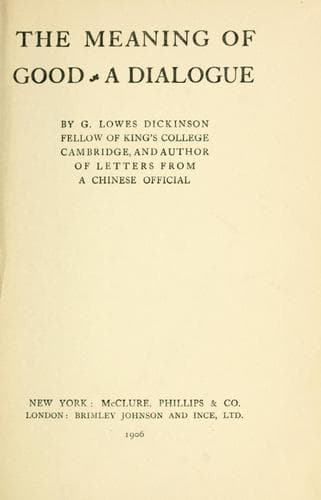
The Meaning of Good—A DialogueDickinson, G. Lowes (Goldsworthy Lowes)
Philosophy
The Meaning of Good—A Dialogue
Dickinson, G. Lowes (Goldsworthy Lowes)
Good and evil
"No," I replied, "only I thought I had shown that if we know nothing
about it, then, for us, it has no meaning; and so our first assumption
is also destroyed, and with it all significance in life."
"Well," he said, "go on. We can't go over all that again."
"Third," I continued, "that among our experiences the one which comes
nearest to Good is that which we called love."
"Possible!" said Dennis, "but a very tentative approximation."
"Certainly," I agreed, "and subject to constant revision."
"And after that?"
"Well," I said, "now comes the point Audubon raised. Is it necessary
to include also the postulate that Good can be realized?"
"But surely," objected Wilson, "here at least there is no room for
what you call faith. For whether or no the Good can be realized is a
question of knowledge."
"No doubt," I replied, "and so are all questions--if only we could
know. But I was assuming that this is one of the things we do not
know."
"But," he said, "it is one we are always coming to know. Every year we
are learning more and more about the course and destiny of mankind."
"Should you say, then," I asked, "that we are nearer to knowing
whether or no the soul is immortal?"
He looked at me in sheer amazement; and then, "What a question!" he
cried. "I should say that we have long known that it isn't"
"Then," I said, "if so, we know that the Good cannot be realized."
"What!" he exclaimed. "I had not understood that your conception of
the Good involved the idea of personal immortality."
"I am almost afraid it does," I replied, "but I am not quite sure.
We have already touched upon the point, if you remember, when we
were considering whether we must regard the Good as realizable in
ourselves, or only in some generation of people to come. And we
thought then that it must somehow be realizable in us."
"But we did not see at the time what that would involve, though I was
afraid all along of something of the kind."
"Well," I said, "for fear you should think you have been cheated, we
will reconsider the point; and first, if you like, we will suppose
that we mean by the Good of some future generation, still retaining
for Good the signification we gave to it. The question then of whether
or no the Good can be realized, will be the question whether or no it
is possible that at some future time all individuals should be knit
together in that ultimate relation which we called love."
"But," cried Leslie, "the love was to be eternal! So that _their_
souls at least would have to be immortal; and if theirs, why not
ours?"
I looked at Wilson; and "Well," I said, "what are we to say?"
"For my part," he replied, "I have nothing to say. I consider the
whole idea of immortality illegitimate."
"Yet on that," I said, "hangs the eternal nature of our Good. But may
we retain, perhaps, the all-comprehensiveness?"
"How could we!" cried Leslie, "for it is only the individuals who
happened to be alive who could be comprehended so long as they were
alive."
Public-domain text, read in full here on John Shaqi.
Reviews
Reviews
No reviews yet
Be the first to share your thoughts on this work.
Elsewhere in the archive
Join the Discussion
Join the discussion
Sign in to leave a comment or review.
Sign InorCreate an account