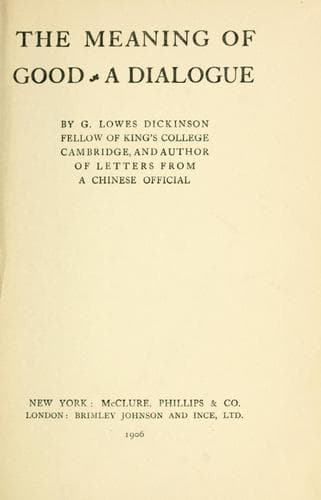
The Meaning of Good—A DialogueDickinson, G. Lowes (Goldsworthy Lowes)
Philosophy
The Meaning of Good—A Dialogue
Dickinson, G. Lowes (Goldsworthy Lowes)
Good and evil
"But," I said, "even if it be, that does not prove that it is not
true; it merely shows that we have no sufficient reason for thinking
it to be true."
"Well," he said, "put it so, if you like; that is enough to relegate
the notion to the limbo of centaurs and chimæras. What we have no
reason to suppose to be true, we have no reason to concern ourselves
with."
"Pardon me," I replied, "but I think we have, if the idea is one that
interests us, as Is the case with what we are discussing. We may not
know whether or no it is true, but we cannot help profoundly caring."
"Well," he said, "I may be peculiarly constituted, but, honestly, I do
not myself care in the least"
"But," I said, "perhaps you ought to, if you care about the Good;
and that is really the question I want to come back to. What is the
minimum we must believe if we are to make life significant? Is it
sufficient to believe in what you call the 'progress of the race'? Or
must we also believe in the progress of the individual, involving, as
it does, personal immortality?"
"Well," said Wilson, "I don't profess to take lofty views of
life--that I leave to the philosophers. But I must say it seems to me
to be a finer thing to work for a future in which one knows one will
not participate oneself than for one in which one's personal happiness
is involved. I have always sympathized with Comte, pedant as he was,
in the remark he made when he was dying."
"Which one?" interrupted Ellis. "'Quelle perte irréparable?' That
always struck me as the most humorous thing ever said."
"No," said Wilson, gravely, "but when he said that the prospect of
death would be to him infinitely less sublime, if it did not involve
his own extinction; the notion being, I suppose, that death is
the triumphant affirmation of the supremacy of the race over the
individual. And that, I think myself, is the sound and healthy and
manly view."
"My dear Wilson," cried Ellis, "you talk of lofty views; but this is
a pinnacle of loftiness to which I, for one, could never aspire.
Positively, to rejoice in the extinction of the individual with his
faculties undeveloped, his opportunities unrealized, his ambitions
unfulfilled--why it's sublime! its Kiplingese--there's no other word
for it! Shake hands, Wilson! you're a hero."
"Really," said Wilson, rather impatiently, "I see nothing strained
or high-faluting in the view. And as to what you say about faculties
undeveloped and the rest, that seems to me unreal and exaggerated!
Most men have a good enough time, and get pretty much what they
deserve. A healthy, normal man is ready to die--he has done what he
had it in him to do, and passed on his work to the next generation."
"I have often wondered," said Ellis, meditatively, "what 'normal'
means. Does it mean one in a million, should you say? Or perhaps that
is too large a proportion? Some people say, do they not, that there
never was a normal man?"
Public-domain text, read in full here on John Shaqi.
Reviews
Reviews
No reviews yet
Be the first to share your thoughts on this work.
Elsewhere in the archive
Join the Discussion
Join the discussion
Sign in to leave a comment or review.
Sign InorCreate an account