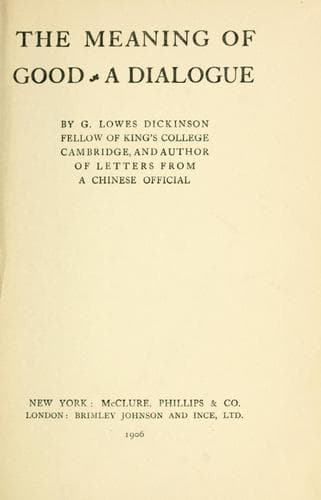
The Meaning of Good—A DialogueDickinson, G. Lowes (Goldsworthy Lowes)
Philosophy
The Meaning of Good—A Dialogue
Dickinson, G. Lowes (Goldsworthy Lowes)
Good and evil
"By 'normal,'" retorted Wilson, doggedly, "I mean average, and I
include every one except a few decadents and faddists."
At this point, seeing that we were threatened with another digression,
I thought it best to intervene again.
"We are diverging," I said, "a little from the issue. Wilson's
position, as I understand him, is that the prospect of the future
Good of the race is sufficient to give significance to the life of the
individual, even though he realize no Good for himself."
"No," replied Wilson, "I don't say that; for I think he always does
realize sufficient Good for himself."
"But is it because of that Good which he realizes for himself that his
life has significance? Or because of the future Good of the race?"
"I don't know; both, I suppose."
"You do not think then that the future Good of the race is sufficient,
by itself, to give significance to the lives of individuals who are
never to partake in it?"
"I don't like that way of putting the question. What I believe is,
that in realizing his own Good a man is also contributing to that of
the race. There is no such antagonism between the two ends as you seem
to suggest."
"I don't say that there is an antagonism; but I do insist that there
is a distinction. And I cannot help feeling--and this is where we seem
to disagree--that in estimating the Good of individual lives we must
have regard to that which they realize in and for themselves, not
merely to that which they may be contributing to produce some day in
somebody else."
"These 'somebody elses,'" cried Ellis, "being after all nothing but
other individuals like themselves! so that you get an infinite series
of people doing Good to one another, and none of them getting any
Good for themselves, like the: islanders who lived by taking in one
another's washing!"
"Well, but," said Wilson, "supposing I consent, for the sake of
argument, to let you estimate the worth of life by the Good which
individuals realize in themselves. What follows then?"
"Why, then" I said, "it would, I think, be very hard to maintain that
we do most of us realize Good enough to make it seem worth while to
have lived at all, if indeed we are simply extinguished at death. At
any rate, if we set aside an exceptional few, and look frankly at the
mass of men and women, judging them not as means to something else,
but as ends in themselves, with reference not to happiness, or
content, or acquiescence, or indifference, but simply to Good--if we
look at them so, can we honestly say that there is enough significance
in their lives to justify the labour and expense of producing and
maintaining them?"
"I don't know," he replied, "they probably think themselves that there
is."
"Probably," I rejoined, "they do not think about it at all. But what I
should like to know is, what do you think?"
"I don't see," he objected, "how I can have any opinion; the problem
is too vast and indeterminate."
Public-domain text, read in full here on John Shaqi.
Reviews
Reviews
No reviews yet
Be the first to share your thoughts on this work.
Elsewhere in the archive
Join the Discussion
Join the discussion
Sign in to leave a comment or review.
Sign InorCreate an account