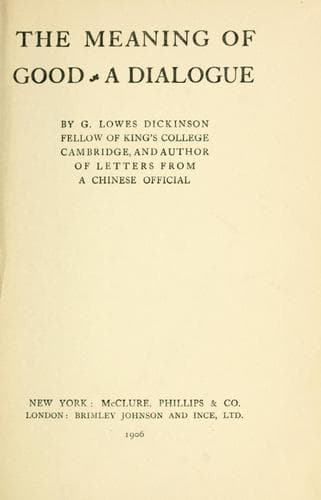
The Meaning of Good—A DialogueDickinson, G. Lowes (Goldsworthy Lowes)
Philosophy
The Meaning of Good—A Dialogue
Dickinson, G. Lowes (Goldsworthy Lowes)
Good and evil
"If that be so," I replied, "the method of judging about Good can
certainly not be scientific; for judgments about Good are judgments of
what ought to be, not of what is."
"But then," objected Wilson, "what method is left you? You have
nothing to fall back upon but a chaos of opinions."
"But might there not be some way of judging between opinions?"
"How should there be, in the absence of any external objective test?"
"What do you mean by that?"
"Why," he replied, "the kind of test which you have in the case of the
sciences. They depend, in the last resort, not on ideas of ours,
but on the routine of common sense-perception; a routine which is
independent of our choice or will, but is forced upon us from without
with an absolute authority such as no imaginings of our own can
impugn. Thus we get a certainty upon which, by the power of inference,
whose mechanism we need not now discuss, we are able to build up a
knowledge of what is. But when, on the other hand, we turn to such of
our ideas as deal with the Good, the Beautiful, and the like--here
we have no test external to ourselves, no authority superior and
independent. Invite a group of men to witness a scientific experiment,
and none of them will be able to deny either the sequence of the
phenomena produced, or the chain of reasoning (supposing it to be
sound) which leads to the conclusion based upon them. Invite the same
men to judge of a picture, or consult them on a question of moral
casuistry, and they will propound the most opposite opinions; nor will
there be any objective test by which you can affirm that one opinion
is more correct than another. The deliverances of the external sense
are, or at least can be made, by correction of the personal equation,
infallible and the same for all; those of the internal sense are
different not only in different persons, but in the same person at
different times."
"Yes," said Leslie, impatiently, "we have all admitted that! The
question is whether--"
"Excuse me," Wilson interposed, "I haven't yet come to my main point.
I was going to say that not merely are there these differences
of opinion, but even if there were not, even if the opinions were
uniform, they would still, as opinions, be subjective and devoid
of scientific validity. It is the external reference that gives its
certainty to science; and such a reference is impossible in the case
of judgments about the Beautiful and the Good. Such judgments are
merely records of what we think or feel. These ideas of ours may or
may not happen to be consistent one with another; but whether they are
so or not, they are merely our ideas, and have nothing to do with the
essential nature of reality."
Public-domain text, read in full here on John Shaqi.
Reviews
Reviews
No reviews yet
Be the first to share your thoughts on this work.
Join the Discussion
Join the discussion
Sign in to leave a comment or review.
Sign InorCreate an account