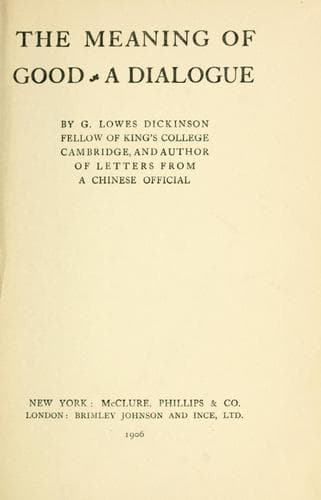
The Meaning of Good—A DialogueDickinson, G. Lowes (Goldsworthy Lowes)
Philosophy
The Meaning of Good—A Dialogue
Dickinson, G. Lowes (Goldsworthy Lowes)
Good and evil
"As to that," I replied, "I would rather not say anything about it
just now. On the logical point you may be right; but that, I think,
need not at present detain us, because what I am trying to get at, for
the moment, is something rather different. I will put it like this:
Good, if it is to be conceived as an object of human action, must be
conceived, must it not, as an object of consciousness? For otherwise
do you think we should trouble to pursue it?"
"I don't know," he said, "whether we should; but perhaps we ought to."
"But," I urged, "do you really think we ought? Do you think, to take
an example, that it could be a possible or a right aim for an
artist, say, to be perpetually producing, in a state of complete
unconsciousness, works which on completion should be immediately
hermetically sealed and buried for all eternity at the bottom of the
sea? Do you think that he could or ought to consider such production
as a Good? And so with all the works of man. Do we, and really ought
we to, do anything except with some reference to consciousness?"
"I don't know whether we do," he replied, "but I think it quite
possible that we ought."
"Well," I said, "we shall not, I suppose, just now, come to a closer
agreement But is there anyone else who shares your view? for, if not,
I will, with your permission, go on to the next point"
None spoke, and Dennis made no further opposition. So, after a pause,
I proceeded as follows: "I shall assume, then, that Good, in the sense
in which I am conceiving it, as an end of human action, involves some
kind of conscious activity. And the next question would seem to be,
activity of whom?"
"That, at any rate," said Leslie, "appears to be simple enough. It
must be an activity of some person or persons."
"Once more," murmured Dennis, "I protest."
But this time I ventured to ignore him, and merely said, in answer to
Leslie, "The question, then, will be, what persons?"
"Why," he replied, "ourselves, I suppose!"
"What do you say, Parry?" I asked.
"I don't quite understand," he replied, "the kind of way you put your
questions. But my own idea has always been, what I suppose is most
people's now, that the Good we are working for is that of some future
generation."
At this Leslie made some inarticulate interjection, which I thought
it better to ignore. And, answering Parry, I said, "Suppose, then, we
were to make a beginning by examining your hypothesis."
"By all means," he said, "though I should have thought we should all
have accepted it--unless, perhaps, it were Dennis."
"I most certainly don't!" cried Leslie.
"Nor I," added Audubon.
"Oh you!" cried Parry, "you accept nothing!"
"True"; he replied, "my motto is 'j'attends.'"
"Well," I resumed, "let us follow the argument and see where it leads
us. The hypothesis is, that Good involves some state of activity of
some generation indefinitely remote. Is not that so, Parry?"
Public-domain text, read in full here on John Shaqi.
Reviews
Reviews
No reviews yet
Be the first to share your thoughts on this work.
Elsewhere in the archive
Join the Discussion
Join the discussion
Sign in to leave a comment or review.
Sign InorCreate an account