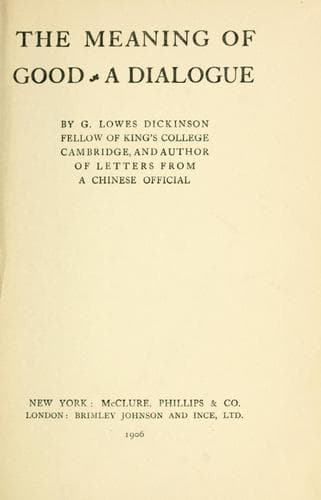
The Meaning of Good—A DialogueDickinson, G. Lowes (Goldsworthy Lowes)
Philosophy
The Meaning of Good—A Dialogue
Dickinson, G. Lowes (Goldsworthy Lowes)
Good and evil
They agreed to take me on my own terms, and I was about to begin,
when, happening to catch Dennis' eye, I suddenly felt discouraged.
"After all," I said, "I doubt whether it's much use my making the
attempt."
"Why, what's the matter?"
"Nothing," I said. "At least--well, I may as well confess it, though
it seems like giving away my whole case. The fact is, that there are
certain quite fundamental points in this connection on which Dennis
and I have never been able to agree; and although I believe we should
in time come to understand one another, I doubt whether we can do so
here and now. At any rate, he doesn't look at all as if he meant
to make it easy for me; and if I cannot carry him along with me, I
suppose I may as well give up at once."
"Oh," said Audubon, "if that is all, I will make a concession. We
will leave Dennis out of the reckoning. It shall be enough if you can
persuade the rest of us."
"But," I urged, "I doubt, even so, whether Dennis will ever allow me
to get to the end. You see, he never lets things pass if he doesn't
happen to agree."
"Oh," cried Ellis, "it's all right. We will keep him in order."
Dennis laughed. "You're disposing of me," he said, "in a very easy
manner. But perhaps I had better go away altogether; for, if I stay, I
certainly cannot pledge myself not to interrupt."
"No," I said, "that seems hardly fair. What I propose is, that we
should both try to be as conciliatory as we can. And then, by the
process of 'give and take,' I shall perhaps slip past you without any
really scandalous concession on either side."
"Well," he said, "you can try."
So, after casting about in my mind, I began, with some hesitation, as
follows:
"The first thing, then, that I want to say is this: Good, as it seems
to me, necessarily involves some form of conscious activity."
As I had expected, Dennis interrupted me at once.
"I don't see that at all," he said. "Consciousness may have nothing to
do with it."
"Perhaps, indeed, it may not," I replied, with all the suavity I could
command. "I should rather have said that I, as a matter of fact, can
form no idea of Good except in connection with consciousness."
"Can you not?" he exclaimed, "but I can! If a thing is good it's good,
so it appears to me, whether or no there is any consciousness of it."
"But," I said, "I, you see, myself, have no experience of anything
existing apart from consciousness, so it is difficult for me to
know whether such a thing would be good or no. But you, perhaps, are
differently constituted."
"Not in that point," he replied. "I admit, of course, that there is no
experience without consciousness. But we can surely conceive that of
which we have no experience? And I should have thought it was clear
that Good, like Truth, _is_, whether or no anyone is aware of it. Or
would you say that 2 + 2 = 4 is only true when someone is thinking of
it?"
Public-domain text, read in full here on John Shaqi.
Reviews
Reviews
No reviews yet
Be the first to share your thoughts on this work.
Elsewhere in the archive
Join the Discussion
Join the discussion
Sign in to leave a comment or review.
Sign InorCreate an account