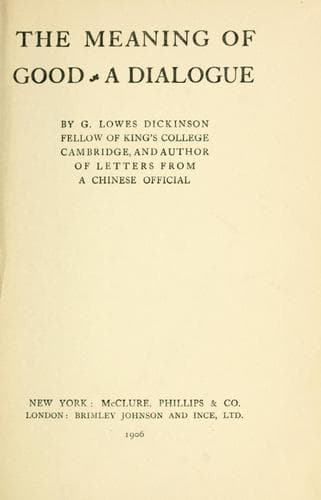
The Meaning of Good—A DialogueDickinson, G. Lowes (Goldsworthy Lowes)
Philosophy
The Meaning of Good—A Dialogue
Dickinson, G. Lowes (Goldsworthy Lowes)
Good and evil
"Well," he rejoined, "whatever you may say, I still think it right
that each generation should sacrifice itself (as you call it) for the
next. And so, I believe, would you, when it came to the point. At any
rate, I have often heard you inveigh against the shortsightedness of
modern politicians, and their unwillingness to run great risks and
undertake great labours for the future."
"Quite true," I said, "that is the view I take. But I was trying to
see how the view could be justified. For it seems to me, I confess,
that we can only be expected to labour for what is, in some sense
or other, our own Good; and I do not see how the Good of future
generations, in your way of putting it, is also ours."
"But," he said, "we have an instinct that it is."
"I believe we have," I replied, "but the question would be, what that
instinct really means. Somehow or other, I think it must mean, as you
yourself suggested, that our Good is the Good of the Whole. Only the
difficulty is to see how there is a Whole at all."
"Well," he said, "perhaps there is no Whole. What then?"
"Why, then," I replied, "how can we justify an instinct which bids us
labour and sacrifice ourselves for a Good, which, on this hypothesis,
has no significance for us, but only for other people."
"Perhaps," he said, "we cannot justify it, but I am sure we ought to
obey it; and, indeed, I believe we cannot do otherwise. Even taking
the view that the order of the world is altogether unjust, as I admit
it would be on the view we are considering, yet, since we cannot
remedy the injustice, we are bound at least to make the best of it;
and the best we can do is to prepare the Good for those who come after
us, even though we can never enter into it ourselves."
"I am not so sure about that," Ellis interrupted, "I think the best
we can do is to try and realize Good for ourselves--as much as we
can get, even if we admit that this is but little. For we do at least
know, or may hope to discover, what Good for ourselves is; whereas
Good for other people is far more hypothetical."
"But, surely," he objected, "that would lead to action we cannot
approve--to a sacrifice of all larger Goods to our own pleasure of the
moment. We should breed, for example, without any regard to the future
efficacy of the race----"
"That," interrupted Ellis, "we do as it is."
"Yes, but we don't justify it--those of us, at least, who think. And,
again, we should squander on immediate gratifications wealth which
ought to be stored up against the future. And so on, and so on; it is
not necessary to multiply examples."
Public-domain text, read in full here on John Shaqi.
Reviews
Reviews
No reviews yet
Be the first to share your thoughts on this work.
Elsewhere in the archive
Join the Discussion
Join the discussion
Sign in to leave a comment or review.
Sign InorCreate an account