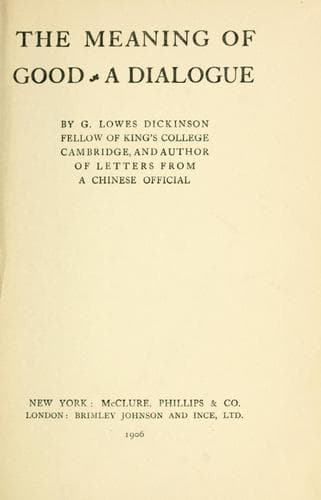
The Meaning of Good—A DialogueDickinson, G. Lowes (Goldsworthy Lowes)
Philosophy
The Meaning of Good—A Dialogue
Dickinson, G. Lowes (Goldsworthy Lowes)
Good and evil
"But," I objected, "we should only do these things if we thought that
kind of short-sighted activity to be good; but, as a matter of fact,
we do not, we who object to it. And that is because, as I hinted
before, our idea of even our own Good is that of an activity in and
for the Whole, and not merely in and for ourselves. And, whether it is
reasonable or no, we cannot help extending the idea of the Whole, so
as to include future generations. But, as it seems to me, the real
meaning and justification of our action is not merely that we are
seeking the Good of future generations but that we are endeavouring to
realize our own Good, which consists in some such form of activity. So
that really, as was suggested at the beginning, Good will be a kind of
activity in ourselves, even though that activity be directed towards
ends in which we do not expect to share."
At this point, Dennis, who had been struggling to speak, broke in at
last, in spite of Ellis's efforts to restrain him.
"Why do you keep saying '_Our_ Good'?" he cried. "Why do you not say
_the_ Good? I can't understand this talk of me and thee, our Good, and
their Good, as if there were as many Goods as there are people."
"Well," I said, "the distinction, after all, was introduced by Parry,
who said that we ought to aim at the Good of a future generation.
Still, I admit that I was getting a little unhappy myself at the kind
of language into which I was betrayed. But what I want to say is
this: So far as it is true at all that it is good to labour for future
generations, goodness consists in the activity of so labouring, as
much, at least, as in the result produced in those for whose sake the
labour is. That, at least, is the only way in which I can find the
position reasonable at all."
"I don't see it," said Parry, and was preparing to re-state his
position, when Wilson suddenly intervened with a new train of thought.
"The fact is," he said, "you have begun altogether at the wrong end."
"I daresay," I said, "I can't find the end; it's all such a coil."
"Well," he said, "this is where I believe the trouble came in. You
started with the idea that the Good must be good for individuals; and
that was sure to land you in confusion."
"What then is your idea?" I asked.
"Why," he said, "as you might expect from a biologist, I regard
everything from the point of view of the species."
At this I saw Ellis sit up and prepare for an encounter.
"Nature," continued Wilson, "has always in view the Whole not the
Part, the species not the individual. And this law, which is true of
the whole creation, is thrown into special relief in the case of man,
because there the interest of the species is embodied in a particular
form--the Society or the State--and may be clearly envisaged, as a
thing apart, towards the maintenance of which conscious efforts may be
directed."
"And this, which is the end of Nature, according to you, is also the
Good?"
"Naturally."
Public-domain text, read in full here on John Shaqi.
Reviews
Reviews
No reviews yet
Be the first to share your thoughts on this work.
Elsewhere in the archive
Join the Discussion
Join the discussion
Sign in to leave a comment or review.
Sign InorCreate an account