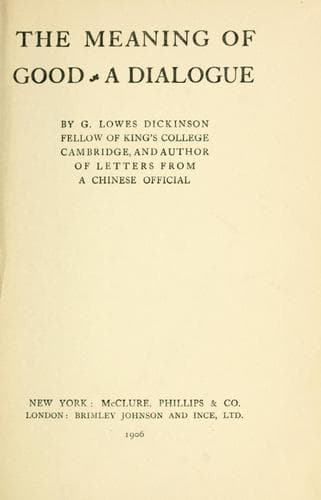
The Meaning of Good—A DialogueDickinson, G. Lowes (Goldsworthy Lowes)
Philosophy
The Meaning of Good—A Dialogue
Dickinson, G. Lowes (Goldsworthy Lowes)
Good and evil
"Oh, do we!" said Audubon.
"We," answered Ellis, "not you! You, of course, do not accept
anything."
"But who are 'we'?" asked Leslie.
"All of us," he replied, "who try to make an art of living. Yes, art,
that is the word! To me life appears like a great tragi-comedy. It has
its shadows as well as its lights, but we would not lose one of them,
for fear of destroying the harmony of the whole. Call it good, or call
it bad, no matter, so it is. The villain no less than the hero claims
our applause; it would be dull without him. We can't afford to miss
anything or anyone."
"In fact," cried Audubon, "'Konx Ompax! Totality!' You and Dennis are
strangely agreed for once!"
"Yes," he replied, "but for very different reasons, as the judge said
on the one occasion when he concurred with his colleagues. Dennis
accepts the Whole because he finds it a perfect logical system; I,
because I find it a perfect work of art. His prophet is Hegel; mine is
Walt Whitman."
"Walt Whitman! And you profess to be an artist!"
"So was he, not in words but in life. One thing to him was no better
nor worse than another; small and great, high and low, good and
bad, he accepts them all, with the instinctive delight of an actual
physical contact. Listen to him!" And he began to quote:
"I do not call one greater and one smaller,
That which fills its period and place is equal to any.
I believe a leaf of grass is no less than the journey-work of the stars.
And the pismire is equally perfect, and a grain of sand, and the egg of
the wren,
And the tree-toad is a 'chef-d'oeuvre' for the highest;
And the running blackberry would adorn the parlours of heaven,
And the narrowest hinge in my hand puts to scorn all machinery,
And the cow-crunching with depressed head surpasses any statue,
And a mouse is miracle enough to stagger sextillions of infidels."
"That's all very well," objected Leslie, "though, of course, it's
rather absurd; but it does not touch the question of evil at all."
"Wait a bit," cried Ellis, "he's ready for you there."
"I am not the poet of goodness only, I do not decline to be the poet of
wickedness also.
What blurt is this about virtue and about vice?
Evil propels me and reform of evil propels me, I stand indifferent,
My gait is no fault-finder's or rejector's gait,
I moisten the roots of all that grows."
* * * * *
"This is the meal equally set, this is the meat for natural hunger,
It is for the wicked just the same as the righteous, I make appointment
with all,
I will not have a single person slighted or kept away,
The kept-woman, spunger, thief are hereby invited,
The heavy-lipped slave is invited, the venerealee is invited;
There shall be no difference between them and the rest."
"That's rather strong," remarked Parry.
"Don't you like it?" Ellis inquired.
"I think I might like it if I were drunk."
"Ah, but a poet, you see, is always drunk!"
Public-domain text, read in full here on John Shaqi.
Reviews
Reviews
No reviews yet
Be the first to share your thoughts on this work.
Elsewhere in the archive
Join the Discussion
Join the discussion
Sign in to leave a comment or review.
Sign InorCreate an account