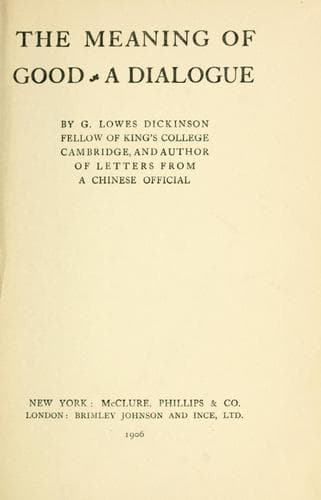
The Meaning of Good—A DialogueDickinson, G. Lowes (Goldsworthy Lowes)
Philosophy
The Meaning of Good—A Dialogue
Dickinson, G. Lowes (Goldsworthy Lowes)
Good and evil
'Well, I unfortunately, am often sober; and then I find the sponger
and the venerealee anything but agreeable objects."
"Besides," said Audubon, "though it's very good of Walt Whitman to
invite us all, the mere fact of dining with him, however miscellaneous
the company, doesn't alter the character of the dinner."
"No," cried Leslie, "and that's just the point Ellis has missed all
through. Even if it be true that the world appears to him as a work of
art, it doesn't appear so to the personages of the drama. What's play
to him is grim earnest to them; and, what's more, he himself is an
actor not a mere spectator, and may have that fact brought home to
him, any moment, in his flesh and blood."
"Of course!" replied Ellis, "and I wouldn't have it otherwise. The
point of the position is that one should play one's part oneself,
but play it as an artist with one's eye upon the total effect, never
complaining of Evil merely because one happens to suffer, but taking
the suffering itself as an element in the æsthetic perfection of the
Whole."
"I should like to see you doing that," said Bartlett, rather brutally,
"when you were down with a fit of yellow fever."
"Or shut up in a mad-house," said Leslie.
"Or working eight hours a day at business," said Audubon, "with the
thermometer 100 degrees in the shade."
"Oh well," answered Ellis, "those are the confounded accidents of our
unhealthy habits of life."
"I am afraid," I said, "they are accidents very essential to the
substance of the world."
"Besides," cried Parry, "there's the whole moral question, which you
seem to ignore altogether. If there be any activity that is good,
it must be, I suppose, the one that is right; and the activity you
describe seems to have nothing to do with right and wrong."
"Right and wrong! Right and wrong!" echoed Ellis,
"Das hör ich sechzlg Jahre wiederholen,
Ich fluche drauf, aber verstohlen."
"You may curse as much as you like," replied Parry, "but you can
hardly deny that there is an intimate connection between Good and
Right."
Instead of replying Ellis began to whistle; so I took up Parry's point
and said, "Yes, but what is the connection? My own idea is that Right
is really a means to Good. And I should separate off all activity
that is merely a means from that which is really an end in itself, and
good."
"But is there any activity," objected Leslie, "which is not merely a
means?"
"Oh yes," I said, "I should have thought so. Most men, it seems to
me, are well enough content with what they are doing for its own sake;
even though at the same time they have remoter ends in view, and if
these were cut off would cease, perhaps, to take pleasure in the work
of the moment. The attitude is not very logical, perhaps, but I think
it is very common. Why else is it that men who believe and maintain
that they only work in order to make money, nevertheless are so
unwilling to retire when the money is made; or, if they do, are so
often dissatisfied and unhappy?"
Public-domain text, read in full here on John Shaqi.
Reviews
Reviews
No reviews yet
Be the first to share your thoughts on this work.
Elsewhere in the archive
Join the Discussion
Join the discussion
Sign in to leave a comment or review.
Sign InorCreate an account