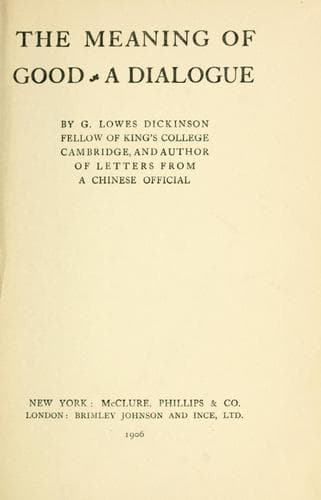
The Meaning of Good—A DialogueDickinson, G. Lowes (Goldsworthy Lowes)
Philosophy
The Meaning of Good—A Dialogue
Dickinson, G. Lowes (Goldsworthy Lowes)
Good and evil
This suggestion, unexpected as it was, threw me into great perplexity.
I did not see exactly how to meet it; yet it awakened no response in
me, nor as I thought In any of the others. But while I was hesitating,
Leslie began:
"Do you mean that the Good might consist simply in doing what we
ought, without any other accompaniment or conditions?"
"Yes, I think it might."
"So that, for example, a man might be in possession of the Good, even
while he was being racked or burnt alive, so long only as he was doing
what he ought"
"Yes, I suppose he might be."
"It's a trifle paradoxical," said Ellis.
"In fact," added Bartlett, "it might be called nonsense."
"I don't see why," replied Dennis; "for we haven't yet shown that the
Good is dependent on the things we call good."
"No," I said, "but we did show--or at least for the time being we
agreed to admit--that it must have some relation to what we call
goods; that they do somehow or other, and more or less, express
its nature; and indeed our whole present inquiry is based upon the
hypothesis that it is by examining goods that we may get to know
something about the Good. So that I do not see how we can entertain an
idea of Good which flatly contradicts all our experience of goods."
"Well," said Dennis, "I ought perhaps to modify the position. Let us
say that the Good consists in the activity of doing what we ought,
only that activity can't exist in its true perfection unless everybody
participates in it at once. But if everybody participated in it,
there would be no more burnings; and so Leslie's difficulty would not
arise."
"Well," I said, "the modification is very radical! But even so, I
don't know what to make of the position. For it is very difficult to
conceive a society perpetually and exclusively occupied, so to speak,
in 'oughting.' Just imagine the kind of life It would be--without
pleasure, without business, without knowledge, without anything at all
analogous to what we call good, purged wholly and completely of all
that might taint the purity of the moral sense, of philanthropy, of
friendship, of love, even, I suppose, of the love of virtue, a life
simply of obligation, without anything to be obliged to except a law."
"But," he protested, "you are taking an absurd and impossible case."
"I am taking the case which you yourself put, when you said that Good
consisted simply in doing what one ought, independently of all other
accompaniment or condition. But perhaps that is not what you really
meant?"
"No," he said; "of course, what I meant was that it is life according
to the moral law that is Good; but I did not intend to separate the
law from the life, and call it Good all by itself."
"But is the life the better for the law, in the sense, I mean, in
which law involves constraint? Or would it not be better still if the
same life were pursued freely for its own sake?"
"Perhaps so."
Public-domain text, read in full here on John Shaqi.
Reviews
Reviews
No reviews yet
Be the first to share your thoughts on this work.
Elsewhere in the archive
Join the Discussion
Join the discussion
Sign in to leave a comment or review.
Sign InorCreate an account