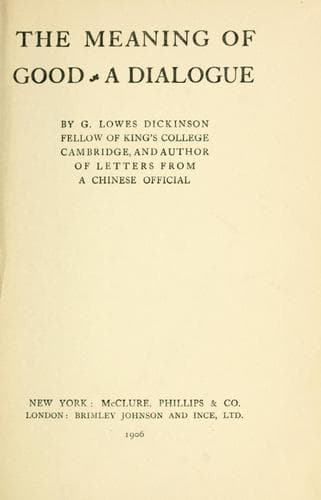
The Meaning of Good—A DialogueDickinson, G. Lowes (Goldsworthy Lowes)
Philosophy
The Meaning of Good—A Dialogue
Dickinson, G. Lowes (Goldsworthy Lowes)
Good and evil
"Oh," said Audubon, "that is only because boredom is worse than pain.
It is not that they find any satisfaction in their work; it's only
that they find even greater distress in idleness."
"But, surely," I replied, "even you yourself would hardly maintain
that there is nothing men do for its own sake, and because they take
delight in it. If there were nothing else at least there is play--and
I have known you play cricket yourself!"
"Known him play cricket!" cried Ellis. "Why, if he had his way, he
would do nothing else, except at the times when he was riding or
shooting."
"Well," I said, "that's enough, for the moment, to refute him. And, in
fact, I suppose none of us would seriously maintain that there is no
form of activity which men feel to be good for its own sake, though
the Good of course may be partial and precarious."
"No," said Ellis, "I should rather inquire whether there is any form
which they pursue merely and exclusively as a means to something
else."
"Oh, surely!" I said. "One might mention, for instance, the act of
visiting the dentist. Or what is more important, and what, I suppose,
Parry had in his mind, there is the whole class of activities which
one distinguishes as moral."
"Do you mean to say," said Parry, "that moral action has no Good in
itself but is only a means to some other Good?"
"I don't know," I replied; "I am rather inclined to think so. But it
all depends upon how we define it."
"And how do you define it?"
"I should say that its specific quality consists in the refusal to
seize some immediate and inferior Good with a view to the attainment
of one that is remoter but higher."
"Oh, well, of course," cried Leslie, "if you define it so, your
proposition follows of itself."
"So I thought," I said. "But how would you define it?"
"I should say it is a free and perfect activity in Good."
"In that case, it is of course the very activity we are in quest of,
and we should come upon it, if we were successful, at the end of our
inquiry. But I was supposing that the essence of morality is expressed
in the word 'ought'; and in that I take to be implied the definition
I suggested--namely, action pursued not for its own sake, but for the
sake of something else."
"Oh, oh!" cried Dennis, "there I really must protest! I've kept silent
as long as I possibly could; but when it comes to describing as a mere
means the only kind of activity which is an end in itself----"
"The only kind that is an end in itself!" I repeated, in some dismay.
"Is that really what you think?"
"Of course it is! why not?"
"I don't know. I have always supposed that, when we are doing what we
ought, we are acting with a view to some ultimate Good."
"Well, I, on the contrary, believe that we ought absolutely, without
reference to anything else. It is a unique form of activity, dependent
on nothing but itself; and for anything we have yet shown, it may be
the Good we are in quest of."
Public-domain text, read in full here on John Shaqi.
Reviews
Reviews
No reviews yet
Be the first to share your thoughts on this work.
Elsewhere in the archive
Join the Discussion
Join the discussion
Sign in to leave a comment or review.
Sign InorCreate an account