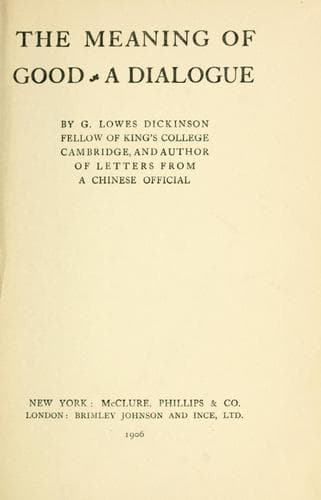
The Meaning of Good—A DialogueDickinson, G. Lowes (Goldsworthy Lowes)
Philosophy
The Meaning of Good—A Dialogue
Dickinson, G. Lowes (Goldsworthy Lowes)
Good and evil
"Have they any?" cried Leslie, "why they have nothing else!"
"Well," I said, "but what in particular?"
"Oh," he replied, "it's all summed up, I suppose, in the fact that
they are Goods of sense, and not of intellect or of imagination."
"Is it then," I asked, "a defect in content that you are driving
at? Do you mean that they satisfy only a part of our nature, not the
whole? For that, I suppose, would be equally true of the other Goods
you mentioned, such as those of the intellect."
"Yes," he replied, "but it is the inferior part to which the Goods we
are speaking of appeal."
"Perhaps; but in what respect inferior?"
"Why, simply as the body is inferior to the soul."
"But how is that? You will think me very stupid, but the more I think
of it the less I understand this famous distinction between body and
soul, and the relation of one to the other."
"I doubt," said Wilson, "whether there is a distinction at all."
"I don't say that," I replied. "I only say that I can't understand
it; and I should be thankful, if possible, to keep it out of our
discussion."
"So should I!" said Wilson.
"Well, but," Leslie protested, "how can we?"
"I think perhaps we might," I said. "For instance, in the case before
us, why should we not try directly to define that specific property of
the Goods of sense which, according to you, constitutes their defect,
without having recourse to these difficult terms body and soul at
all?"
"Well," he agreed, "we might try."
"What, then" I said, "do you suggest?"
He hesitated a little, and then began in a tentative kind of way:
"I think what I feel about these Goods is that we are somehow their
slaves; they possess us, instead of our possessing them. They come
upon us we hardly know how or whence; they satisfy our desires we
can't tell why; our relation to them seems to be passive rather than
active."
"And that, you think, would not be the case with a true and perfect
Good?"
"No, I think not"
"How, then, should we feel towards such a Good?"
"We should feel, I think, that it was somehow an expression of
ourselves, and we of it; that it was its nature and its whole nature
to present itself as a Good and our nature and our whole nature to
experience it as such. There would be nothing in It alien to us and
nothing in us alien to it."
"Whereas in the case of Goods of sense----?"
"Whereas in their case," he said, "surely nothing of the kind applies.
For these Goods appear to arise in things and under circumstances
which have quite another nature than that of being good for us. It is
not the essence of water to quench our thirst, of fire to cook for us,
or of the sun to give us light----"
"Or of cork-trees to stop our ginger-beer bottles," added Ellis.
Public-domain text, read in full here on John Shaqi.
Reviews
Reviews
No reviews yet
Be the first to share your thoughts on this work.
Elsewhere in the archive
Join the Discussion
Join the discussion
Sign in to leave a comment or review.
Sign InorCreate an account