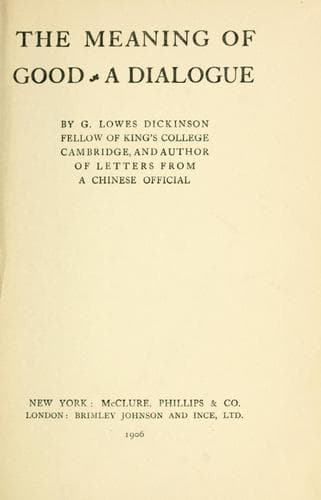
The Meaning of Good—A DialogueDickinson, G. Lowes (Goldsworthy Lowes)
Philosophy
The Meaning of Good—A Dialogue
Dickinson, G. Lowes (Goldsworthy Lowes)
Good and evil
"Quite so," he continued; "in every case these things that do us good
are also quite as ready to do us harm, and, for that matter, to do
innumerable things which have no relation to us at all. So that the
goodness they have in them, so far as it is goodness to our senses,
they have, as it were, only by accident; and we feel that essentially
either they are not Goods, or their goodness is something beyond and
different from that which is revealed to sense."
"Your quarrel, then" I said, "with the Goods of sense, so far as I
understand you, is that they inhere, as it were, in a substance which,
so far as we can tell, is indifferent to Good, or at any rate to Good
of that kind?"
"Yes."
"Whereas a true Good, you think, must be good in essence and
substance?"
"Yes; don't you think so too?"
"I do," I replied, "but how about the others?"
Dennis assented, and the others did not object, not appearing, indeed,
to have attended much to the argument. So I continued, "We have then,
so far, discovered in this class of Goods, two main defects, the
first, that they are precarious; the second, which is closely
connected with the other, and is in fact, I suppose, its explanation,
that they are, shall we say, accidental, understanding the word in
the sense we have just defined. Now, let us see if we cannot find any
class of Goods similar to these, but free from their defects."
"But similar in what respect," he asked, "if they are not to have
similar defects?"
"Similar, I meant, in being direct presentations to sense."
"But are there any such Goods?"
"I think so," I said. "What do you say to works of Art? These, are
they not, are direct presentations to sense? Yet such that it is their
whole nature and essence on the one hand to be beautiful, and to that
extent Good--for I suppose you will admit that the Beautiful is a kind
of Good; and on the other hand, if I may dare to say so, to be, in a
certain sense, eternal."
"Eternal!" cried Ellis, "I only wish they were! What wouldn't we give
for the works of Polygnotus and Apelles!"
"Oh yes," I said, "of course, in that way, regarded as material
objects, they are as perishable as all the works of nature. But I was
talking of them as Art, not as mere things; and from that point of
view, surely, each is a moment, or a series of moments, cut away,
as it were, from the contact of chance or change and set apart in
a timeless world of its own, never of its own nature, to pass into
something else, but only through the alien nature of the matter to
which it is bound."
"What do you mean?" cried Parry. "I am quite at sea."
"Perhaps," I said, "you will understand the point better if I give it
you in the words of a poet."
And I quoted the well-known stanzas from Keats' "Ode on a Grecian
Urn":
Public-domain text, read in full here on John Shaqi.
Reviews
Reviews
No reviews yet
Be the first to share your thoughts on this work.
Elsewhere in the archive
Join the Discussion
Join the discussion
Sign in to leave a comment or review.
Sign InorCreate an account