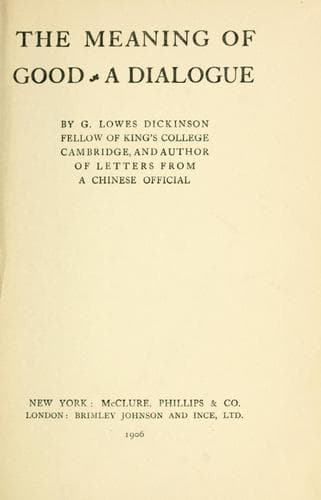
The Meaning of Good—A DialogueDickinson, G. Lowes (Goldsworthy Lowes)
Philosophy
The Meaning of Good—A Dialogue
Dickinson, G. Lowes (Goldsworthy Lowes)
Good and evil
"Real!" cried Leslie. "What is real? The word's the plague of my
life! People use it as if they meant something by it, something very
tremendous and august, and when you press them they never know what
it is. They talk of 'real life'--real life! what is it? As if one life
wasn't as real as another!"
"Oh, as to real life," said Ellis, "I can tell you what that is. Real
life is the shady side of life."
"Nonsense," said Parry, "real life is the life of men of the world."
"Or," retorted Ellis, "more generally, it is the life of the person
speaking, as opposed to that of the person to whom he speaks."
"Well, but," I interposed, "it is not 'real life' that is our present
concern, but Bartlett's meaning when he used the word 'real.' In what
sense is Art not real?"
"Why," he replied, "by your own confession Art is something ideal. It
is beautiful, it is good, it is lifted above chance and change; its
connection with matter, that is to say with reality, is a kind of
flaw, an indecency from which we discreetly turn our eyes. The real
world is nothing of all this; on the contrary, it is ugly, brutal,
material, coarse, and bad as bad can be!"
"I don't see that it is at all!" cried Leslie, "and, even if it were,
you have no right to assume that that is the reality of it. How do you
know that its reality doesn't consist precisely in the Ideal, as all
poets and philosophers have thought? And, in that case, Art would be
more real than what you would call Reality, because it would represent
the essence of the world, the thing it would like to be if it could,
and is, so far as it can. That was Aristotle's view, anyhow."
"Then all I can say is," replied Bartlett, "that I don't agree with
Aristotle! Anyhow, even if Art represents what the world would like to
be, it certainly doesn't represent what it is."
"I don't know; surely it does, sometimes," said Parry, "for instance,
there's the realistic novel!"
"Oh, that!" cried Ellis. "That's the most ideal of all--only it's apt
to be such bad idealism!"
"Anyhow," said Bartlett, "in so far as it is real, it's not Art, in
the sense, in which we have been using the word."
I began to be afraid that we should drift away into a discussion of
realism in Art. So, to recall the conversation to the point at issue,
I turned to Bartlett, and said:
"Your criticism seems to me to be fair enough as far as it goes. You
say that the world of Art is a world by itself; that side by side of
it, and unaffected by it, moves the world of what you call real life.
And that whatever be the relation between the two worlds, whether
we are to say that the one imitates the other, or interprets it, or
idealizes it, it does not, in any case, set it aside. Art is a refuge
from life, not a substitute for it; a little blessed island in the
howling sea of fact. Its Good is thus only a partial Good; whereas the
true Good, I suppose, would be somehow universal."
"Still," said Leslie, "as far as it goes it is a Good without
blemish."
Public-domain text, read in full here on John Shaqi.
Reviews
Reviews
No reviews yet
Be the first to share your thoughts on this work.
Elsewhere in the archive
Join the Discussion
Join the discussion
Sign in to leave a comment or review.
Sign InorCreate an account