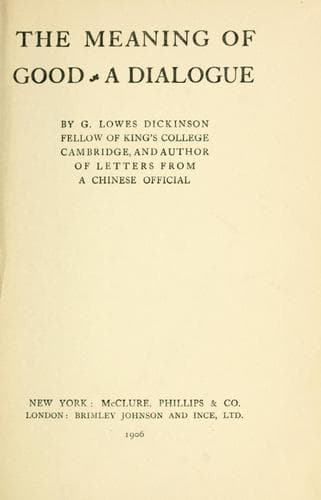
The Meaning of Good—A DialogueDickinson, G. Lowes (Goldsworthy Lowes)
Philosophy
The Meaning of Good—A Dialogue
Dickinson, G. Lowes (Goldsworthy Lowes)
Good and evil
"Why," he replied, "when we come to works of Art, the important thing
is the object, not the subject; if there is any merging of the one in
the other, it is the subject that is merged in the object, not
_vice versa_. We have to contemplate the object, anyhow, as having a
character of its own; and it is to this character that I want to draw
attention."
"In what respect?"
"In respect that every work of Art, and, for that matter, every work
of nature--so far as it can be viewed æsthetically--comprises a number
of elements necessarily connected in a whole; and this necessary
connection is the point on which we ought to insist"
"But necessary how?" asked Wilson. "Do you mean logically necessary?"
"No," he replied, "æsthetically. I mean, that we have a direct
perception that nothing in the work could be omitted or altered
without destroying the whole. This, at any rate, is the ideal; and
it holds, more or less, in proportion as the work is more or less
perfect. Everyone, I suppose, who understands these things would agree
to that."
No one seemed inclined to dispute the statement; certainly I was not,
myself; so I answered, "No doubt what you say is true of works of Art;
but will your contention be that it is also true of Good in general?"
"Yes," he said, "I think so, in so far at least as Good is to be
conceived as comprising a number of elements. For no one, I suppose,
would imagine that such elements might be thrown together haphazard
and yet constitute a good whole."
"I suppose not," I agreed, "and, if you are right, what we seem to
have arrived at is this: among the works which man creates in his
quest of the Good, there is one class, that of works of Art, which, in
the first place, may be said, in a sense, to be not precarious, seeing
that by their form, through which they are Art, they are set above the
flux of time, though by their matter, we admit, they are bound to
it And, in the second place, the Good which they have, they have by
virtue of their essence; Good is their substance, not an accident of
their changing relations. And, lastly, being complex wholes, the parts
of which they are composed are bound together in necessary connection.
These characteristics, at any rate, we have discovered in works of
Art: and no doubt many more might be discoverable. But now, let us
turn to the other side, and consider the defects in which this class
of Goods is involved."
"Ah!" cried Bartlett, "when you come to that, I have something to
say."
"Well," I said, "what is it? We shall be glad of any help."
"It can be summed up," he replied, "in a single word. Whatever may be
the merits of a work of Art--and they may be all that you say--it has
this one grand defect--it isn't real!"
Public-domain text, read in full here on John Shaqi.
Reviews
Reviews
No reviews yet
Be the first to share your thoughts on this work.
Elsewhere in the archive
Join the Discussion
Join the discussion
Sign in to leave a comment or review.
Sign InorCreate an account