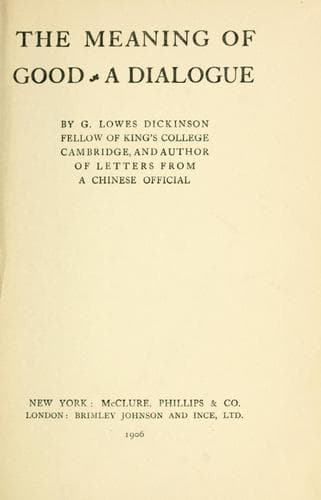
The Meaning of Good—A DialogueDickinson, G. Lowes (Goldsworthy Lowes)
Philosophy
The Meaning of Good—A Dialogue
Dickinson, G. Lowes (Goldsworthy Lowes)
Good and evil
"But it is all based on assumptions."
"That may be; but granting the assumptions, it deduces from them
necessary consequences. And all true science is of that type. A law of
Nature is not a mere description of a routine; it's a statement
that, given such and such conditions, such and such results follow of
necessity."
"Still, you admit that the conditions have to be given! Everything is
based ultimately on certain successions and coincidences of which all
that can be said is simply that they exist, without any possibility of
getting behind them."
"I don't know about that," he said, "but at any rate it would be the
ideal of Knowledge to establish necessary connections throughout; so
that, given any one phenomenon of the universe, all the rest would
inevitably follow. And it is only in so far as it progresses towards
this consummation that Knowledge is Knowledge at all. A routine simply
given without internal coherence is to my mind a contradiction in
terms; either the routine is necessary, or it's not a routine at all,
but at best a mere appearance of a routine."
"I think," I interposed, "we must leave you and Wilson to fight this
out in private. At present, let us assume that your conception of
Knowledge is the true one, as we did with his, and examine it from the
point of view of the Good. Your conception, then, to begin with, seems
to me to be involved in the same defect we have already noted--namely,
that it may be knowledge of Bad just as much as knowledge of Good. And
I suppose you would hardly maintain, any more than Wilson did, that
the Good may consist in knowledge of Bad?"
"But," he objected, "I protest altogether against this notion that
there is Knowledge on the one hand and something of which there is
knowledge on the other. True Knowledge, if ever we could attain to
it, would be a unique kind of activity, in which there would be no
distinction, or at least no antagonism, between thinking on the one
hand and the thing thought on the other."
"I don't know," I said, "that I quite understand. Have we in fact any
knowledge of that kind, that might serve as a kind of type of what you
mean?"
"Yes," he replied, "I think we have. For example, if we are dealing
with pure number, as in arithmetic, we have an object which is somehow
native to our thought, commensurate with it, or however you like
to put it; and it is the same with other abstract notions, such as
substance and causation."
"I see," I said. "And on the other hand, the element which is alien
to thought, and which is the cause of the impurity of most of what we
call knowledge, is the element of sense--the something given, which
thought cannot, as it were, digest, though it may dress and serve it
up in its own sauce?"
"Yes," he said, "that is my idea."
"So that knowledge, to be perfect, must not be of sense, but only of
pure thought, as Plato suggested long ago?"
"Yes."
"And such a knowledge, if we could attain it, you would call the
Good?"
"I think so."
Public-domain text, read in full here on John Shaqi.
Reviews
Reviews
No reviews yet
Be the first to share your thoughts on this work.
Elsewhere in the archive
Join the Discussion
Join the discussion
Sign in to leave a comment or review.
Sign InorCreate an account