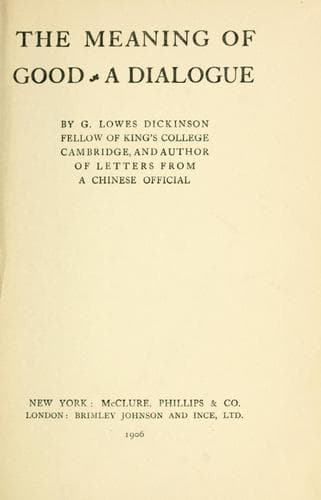
The Meaning of Good—A DialogueDickinson, G. Lowes (Goldsworthy Lowes)
Philosophy
The Meaning of Good—A Dialogue
Dickinson, G. Lowes (Goldsworthy Lowes)
Good and evil
"Well," I said, "in the first place, I have to point out that such a
Good (if it be one) implies an existence not merely better than
that of which we have an experience, but radically and fundamentally
different. For our whole life is bathed in sense. Not only are we sunk
in it up to the neck, but the greater part of the time our heads are
under too,--in fact most of us never get them out at all; it is only
a few philosophers every now and again who emerge for a moment or two
into sun and air, to breathe that element of pure thought which is too
fine even for them, except as a rare indulgence. At other times, they
too must be content with the grosser atmosphere which is the common
sustenance of common men."
"Well," he said, "but what of that? We have not been maintaining that
the Good is within easy reach of all."
"No," cried Ellis. "But even if it were, and were such as you describe
it, very few people would care to put out their hands to take it. I,
at any rate, for my part can see hardly a vestige of Good in the kind
of activity I understand you to mean. It is as though you should say,
that Good consists in the perpetual perception that 2 + 2 = 4."
"But that is an absurd parody. For the point of knowledge would be,
that it would be a closed circle of necessary connections. One would
move in it, as in infinity, with a motion that is also rest, central
at once and peripheral, free and yet bound by law. That is my ideal of
a perfect activity!"
"In form, perhaps," I said, "but surely not in content! For what, in
fact, in our experience comes nearest to what you describe? I suppose
the movement of a logic like Hegel's?"
"Yes; only that, of course, is imperfect, full of lapses and flaws!"
"But even if it were perfect," cried Ellis, "would it be any the
better? Imagine being deprived of the whole content of life--of
nature, of history, of art, of religion, of everything in which we
are really interested; imagine being left to turn for ever, like a
squirrel in a cage, or rather like the idea of a squirrel in the idea
of a cage, round and round the wheel of these hollow notions, without
hands, without feet, without anything anywhere by which we could lay
hold of a something that is not thought, a something solid, resistant,
palpitating, 'luscious and aplomb,' as Walt Whitman might say, a
sense, a flesh, call it what you will, the unintelligible, but still
the indispensable, that which, even if it be bad, we cannot afford to
miss, and which, if it be not the Good itself, the Good must somehow
include!"
Dennis appeared to be somewhat struck by this way of putting the
matter. "But," he urged, "my difficulty is that if you admit sense, or
anything analogous to it, anything at once directly presented and also
alien to thought, you get, as you said yourself, something which is
unintelligible; and a Good which is not intelligible will be, so far,
not good."
"But," I said, "what do you mean by intelligible?"
Public-domain text, read in full here on John Shaqi.
Reviews
Reviews
No reviews yet
Be the first to share your thoughts on this work.
Elsewhere in the archive
Join the Discussion
Join the discussion
Sign in to leave a comment or review.
Sign InorCreate an account