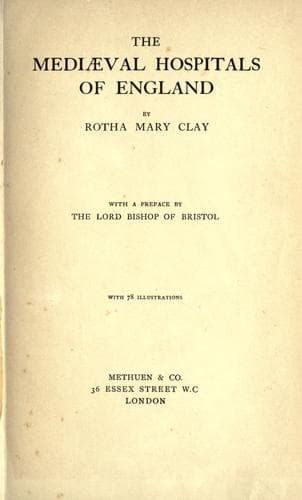
Charities -- Great Britain; Hospitals -- Great Britain; Hospitals, Medieval; Leprosy -- England
“A chyrche of Owre Lady that ys namyde Bedlam. And yn that place
ben founde many men that ben fallyn owte of hyr wytte. And fulle
honestely they ben kepte in that place; and sum ben restoryde unto
hyr witte and helthe a-gayne. And sum ben a-bydyng there yn for
evyr, for they ben falle soo moche owte of hem selfe that hyt ys
uncurerabylle unto man.”
Probably the utterly incurable were doomed to those iron chains,
manacles and stocks mentioned in the inventory of 1398 and quoted at
the visitation of 1403:—
“Item, vj cheynes de Iren, com vj lokkes. Item iiij peir manycles de
Iren. ij peir stokkys.”[22]
In other parts of the country it was customary to receive persons
suffering from attacks of mania into general infirmaries. At
Holy Trinity, Salisbury, not only were sick persons and women in
childbirth received, but mad people were to be taken care of (_furiosi
custodiantur donec sensum adipiscantur_). This was at the [p034] close
of the fourteenth century. In the petition for the reformation of
hospitals (1414) it is stated that they exist partly to maintain those
who had lost their wits and memory (_hors de lour sennes et memoire_).
Many almshouse-statutes, however, prohibited their admission. A
regulation concerning an endowed bed in St. John’s, Coventry (1444),
declared that a candidate must be “not mad, quarrelsome, leprous,
infected.” At Ewelme “no wood man” (crazy person) must be received; and
an inmate becoming “madd, or woode” was to be removed from the Croydon
almshouse.
Such disused lazar-houses as were inhabitable might well have been
utilized as places of confinement. This, indeed, was done at Holloway
near Bath. At what period the lepers vacated St. Mary Magdalene’s is
not known, but it was probably appropriated to the use of lunatics
by Prior Cantlow, who rebuilt the chapel about 1489. At the close of
the sixteenth century, St. James’, Chichester, was occupied by a sad
collection of hopeless cripples, among whom were found two idiots. A
hundred years later the bishop reported that this hospital was of small
revenue and “hath only one poor person, but she a miserable idiot, in
it.”
Bethlehem Hospital was rescued by the Lord Mayor and citizens at the
Dissolution of religious houses and continued its charitable work. In
1560 Queen Elizabeth issued on behalf of this house an appeal of which
a facsimile may be seen in Bewes’ _Church Briefs_. “Sume be straught
from there wyttes,” it declares, “thuse be kepte and mayntend in the
Hospital of our Ladye of Beddelem untyle God caule them to his marcy or
to ther wyttes agayne.”
[Illustration: _PLATE V._ HARBLEDOWN HOSPITAL, NEAR CANTERBURY ONCE
USED FOR LEPERS]
FOOTNOTES:
[22] Char. Com. Rep., xxxii. vi. 472.
[p035]
CHAPTER IV
THE LAZAR-HOUSE
“_For the relief of divers persons smitten with this sickness and
destitute and walking at large within the realm._”[23] (Holloway,
1473.)
Public-domain text, read in full here on John Shaqi.
Reviews
Reviews
No reviews yet
Be the first to share your thoughts on this work.
Join the Discussion
Join the discussion
Sign in to leave a comment or review.
Sign InorCreate an account