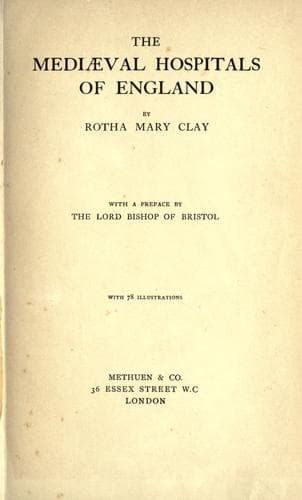
Charities -- Great Britain; Hospitals -- Great Britain; Hospitals, Medieval; Leprosy -- England
One of the questions asked by the official visitor of St. Mary
Magdalene’s, Winchester, was whether the goods of deceased inmates
went to the works of the church after the settlement of debts. In some
hospitals, the rule of poverty was not held, or it was relaxed as
time went on. By the will of William Manning, _lazer_, of the house
of Monkbridge, York (1428), he requests that half a pound of wax be
burnt over his coffin; he leaves 6_d._ to the [p135] works going on
at the Minster, 6_d._ to the Knaresburgh monks, and the residue to his
wife. In the old Scottish version of Troylus and Cresseid, the latter
makes her testament before dying in the spital-house. She had lived in
poverty, but a purse of gold had lately been thrown to her in alms. Her
cup and clapper and her ornament and all her gold the leper folk should
have, when she was dead, if they would bury her. The ruby ring, given
her long ago by her lover, was to be carried back to him by one of her
companions.
Pensioners of the better class were expected to provide all necessary
articles, and to contribute what they could to the funds. Money
acquired during residence was divided, a portion being retained by the
individual; at his death, either half his goods or the whole belonged
to the community. The Heytesbury statutes directed:—
“that euery poreman in his first Admyssion all such moueable goodes
as he hath, pottis, pannys, pewter vessel, beddyng, and other
necessaries, if he haue eny such thynges, to bryng hit within into
the hous. And if he haue eny quycke catell, that hit be made monay
of. And halfe the saide monay to be conuerted to y^e use of y^e hous,
and y^e other halfe to y^e poreman to haue to his own propre use.”
The goods of a deceased member were distributed to those who should
“happe to overlyve,” whether “gownes, hodys, cotys, skertys, hosyn or
shone.” It was ordained at Higham Ferrers that when an almsman died,
his goods were taken into the storehouse, and either dealt out to the
other poor men, or sold to a new inmate for the benefit of the rest.
(b) _Rules of Conduct._—Social intercourse within the house and with
the outside world was clearly defined. Among [p136] habited brethren
and sisters, the sexes were rigidly separated, excepting at worship or
work. In the case of inmates who were not professed, men and women seem
to have lived a common life, meeting in refectory, day room, etc.
Public-domain text, read in full here on John Shaqi.
Reviews
Reviews
No reviews yet
Be the first to share your thoughts on this work.
Elsewhere in the archive
Join the Discussion
Join the discussion
Sign in to leave a comment or review.
Sign InorCreate an account