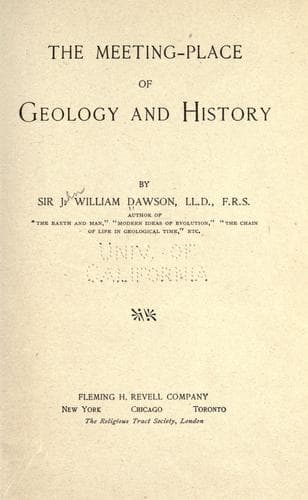
The Meeting-Place of Geology and HistoryDawson, John William, Sir
Religion
The Meeting-Place of Geology and History
Dawson, John William, Sir
Deluge; Prehistoric peoples
It may also be objected that if, as held by some evolutionists, man was
slowly developed from lower animals, and if his earliest known remains
are still human in their characters, he must have had a vastly longer
history covering the periods of his gradual change from, say, ape-like
forms. This is admitted; but then we have as yet no good evidence that
man was so developed, and no remains of intermediate forms are yet known
to science. Even should some animal, either recent or fossil, be
discovered intermediate in structure between man and the highest apes,
we should still require proof that it was the ancestor of man, by the
occurrence of connecting forms, or otherwise. As the facts now stand,
the earliest known remains of man are _still human_, and tell us nothing
as to previous stages of development.
We must now glance a little more particularly at what may be termed the
more immediate antecedents of man. The latest great period of the
earth's geological history (the cenozoic) was ingeniously subdivided by
Lyell, on the ground of the percentages of extinct and surviving species
of marine shells contained in its several beds. According to this
method, which, with some modifications in detail, is still accepted, the
eocene age, or that of the dawn of the recent, includes those formations
in which the percentage of modern or still living species of marine
animals does not exceed three and a half, all the other species found
being extinct. The miocene (less recent) includes beds in which the
percentage of living species does not exceed thirty-five. The pliocene
(more recent) includes beds in which the living forms of marine life
exceed thirty-five per cent, but there is still a considerable
proportion of extinct species. Newer than this we have the pleistocene
(most recent), in which there are scarcely as many extinct species as
there are of recent in the eocene. Lastly, the modern, of course,
includes only the living species of the modern seas. Other geologists,
notably Dawkins and Gandry, have arrived at similar results from a
consideration of the vertebrate animals of the land. In the eocene we
find numerous remains of mammals, or ordinary land quadrupeds, but all
are extinct, and nearly all belong to extinct genera. In the miocene
there are many living genera, but no species that survive to the present
time. The pliocene begins to show a few living species, and these are
dominant in the succeeding pleistocene.
Public-domain text, read in full here on John Shaqi.
Reviews
Reviews
No reviews yet
Be the first to share your thoughts on this work.
Join the Discussion
Join the discussion
Sign in to leave a comment or review.
Sign InorCreate an account