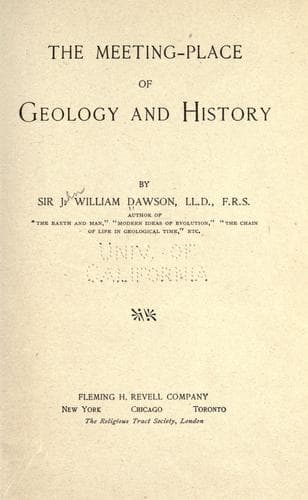
The Meeting-Place of Geology and HistoryDawson, John William, Sir
Religion
The Meeting-Place of Geology and History
Dawson, John William, Sir
Deluge; Prehistoric peoples
The answer of archæology is not doubtful. We have in the earliest
monuments of Chaldea evidence that there was a pre-Semitic population,
to whom, indeed, it is believed that the Semites who invaded the country
owed much of their civilisation. A recent writer has said that 'outside
of the Bible we know nothing of Nimrod,' but others see a trace of him
in the legendary hero of Chaldean tradition, Gisdubar or Gingamos, while
others think that, as Na-marod, he may be the original of Merodach, the
tutelary god of Babylon. Independently of this, there was certainly an
early Chaldean and 'Turanian' empire, which must have had some founder,
whatever his name, and which was not Semitic or Aryan, and therefore
what an early writer would call Hamitic. Further, our author traces from
this region the great Cushite line of migration, which includes such
well-known names as Seba, Sabta, Sheba and Dedan, into Arabia on the way
to Africa. Here the Egyptian monuments take up the tale, and inform us
of a South Arabian and East African people, the people of Pun or Punt,
represented as like to themselves and to the Kesh or Ethiopians, and who
thus correspond to the Arabian Cushites of Genesis. In accordance with
this the Abyssinian of to-day is scarcely distinguishable from the old
Punites as represented on the Egyptian monuments.[79]
[79] The recent discoveries of Glaser with reference to the early
civilisation of Southern Arabia also bear on this point.
Thus the primitive Cushite kingdom and one of the great lines of Cushite
migration are established by ancient monuments. Let it be further
observed that, as represented in Egypt, these primitive Ethiopians were
not black, but of a reddish or brownish colour, like the Egyptians
themselves, and that their migration explains the resemblance of the
customs and religion of early Egypt to those of Babylonia, and the
ascription by the Egyptians of the origin of their gods to the land of
Pun.
The remaining sons of Ham, Mizraim, Put and Canaan, are not mentioned in
connection with the old Nimrodic kingdom, and seem to have moved
westward at a very early period. They were already 'in the land,' and
apparently constituted a considerable citizen population before the
migration of Abraham.
Mizraim represents the twin populations of the delta and Lower Egypt,
and the Tel-el-Amarna tablets inform us that long before the time of
Moses Mitzor was the ordinary name of Egypt, while we know that its
early population was closely allied in features and language to the
Cushites.
Public-domain text, read in full here on John Shaqi.
Reviews
Reviews
No reviews yet
Be the first to share your thoughts on this work.
Elsewhere in the archive
Join the Discussion
Join the discussion
Sign in to leave a comment or review.
Sign InorCreate an account