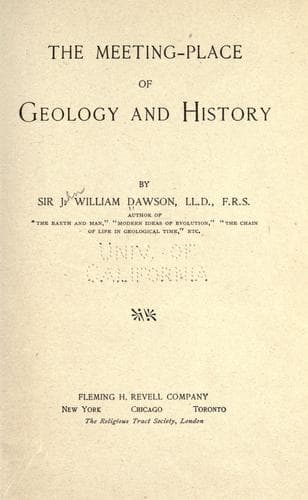
The Meeting-Place of Geology and HistoryDawson, John William, Sir
Religion
The Meeting-Place of Geology and History
Dawson, John William, Sir
Deluge; Prehistoric peoples
[78] Sayce (_Hibbert Lectures_) and Bagster's _Records of the Past_.
Inscriptions of Cyrus published in the last volume of the latter appear
to set at rest the vexed questions relating to early Elam. It would seem
that in the earliest times Cushites and Semitic Elamites contended for
the fertile plains and the mountains east of the Tigris, and were
finally subjugated by Japhetic Medes and Persians. Thus this region
first formed a part of the Cushite Nimrodic empire (Genesis ii. 11, x.
8); it then became the seat of a conquering Elamite power (Genesis xiv.
1 to 4); and was finally a central part of the Medo-Persian empire. All
this agrees with the Bible and the inscriptions, as well as in the main
with Herodotus.
So far as the writer in Genesis is informed, he does not seem to be
aware of any sons of Japhet having colonised Palestine or Egypt. It was
only in the later reflux of population that the sons of Javan gained a
foothold in these regions. They were both colonised primarily by Hamites
and subsequently intruded on by Semites.
Here a little prehistoric interlude noted by the writer, or by an author
whom he quotes, gives a valuable clue not often attended to. The oldest
son of Ham, Cush, begat Nimrod, the mighty hunter and prehistoric
conqueror, who organised the first empire in that Euphratean plain which
subsequently became the nucleus of the Babylonian and Assyrian power.
The site of his kingdom cannot be doubted, for cities well known in
historic times, Babel, Erech, Accad, and Calneh, were included in it, as
well as probably Nineveh. The first point which I wish to make in this
connection is that we cannot suppose this to have been a Semitic empire.
Its nucleus must have been composed of Nimrod's tribal connections, who
were Hamites and presumably Cushites. He is, indeed, said to have gone
into or invaded the land of Ashur, and if by this is meant the Semitic
Ashur, he must have been hostile to these people, as indeed the
Chaldeans were in later times. The next point to be noted is that the
Nimrodic empire must have originated at a time when the Cushites were
still strong on the Lower Euphrates, and before that great movement of
these people which carried them across Arabia to the Upper Nile, and
ultimately caused the name Cush or Kesh to be almost exclusively applied
to the Ethiopians of Africa. Now is this history, or mere legend?
[Illustration: HEAD ILLUSTRATING THE MOST ANCIENT TYPE OF CUSHITE
TURANIAN, FROM TEL-LOH (after de Sarzec). The cap is perhaps an
imitation of the antediluvian shell-caps, like that of the 'man of
Mentorie.']
Public-domain text, read in full here on John Shaqi.
Reviews
Reviews
No reviews yet
Be the first to share your thoughts on this work.
Elsewhere in the archive
Join the Discussion
Join the discussion
Sign in to leave a comment or review.
Sign InorCreate an account