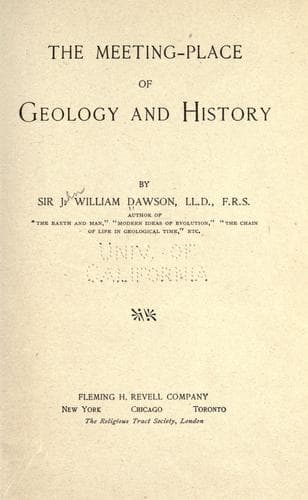
The Meeting-Place of Geology and HistoryDawson, John William, Sir
Religion
The Meeting-Place of Geology and History
Dawson, John William, Sir
Deluge; Prehistoric peoples
The first of these divisions evidently corresponds with the line of
Cushite migration of Genesis, extending from Shinar through Southern
Arabia, Nubia, and Ethiopia, and of which the negroes are apparently
degraded members pushed in advance of the others, while the populations
of Pun and Kesh, the southern Arabians and their relatives in Africa,
closely resemble, as figured in the monuments, the Egyptians themselves.
The second group of the Egyptian classification represents those
so-called Aryan peoples of Europe and its islands, and parts of Northern
Africa, of whom the Greeks are a typical race, and who in Genesis are
said to have possessed the 'Isles of the Gentiles'; though in the wave
of migration from the east they were in many places preceded by
non-Aryan races, Pelasgians, Iberians, &c., possibly wandering Hamitic
tribes, while they were also invaded by that scattering abroad of the
Phœnician Canaanites referred to in Genesis. They are represented in the
monuments as people with European features, fair complexions, and
sometimes fair hair and blue eyes.
The third group is the most varied of the whole, because its seat in
Syria was a meeting-place of many tribes. Its most ancient members, the
Phœnicians and allied nations, were, according to the monuments, men
resembling the Egyptian and Cushite type, and these, no doubt, were
those pre-Semitic and prehistoric nations of Canaan referred to in the
remarkable notes regarding the Emim, Zuzim, &c., in the second chapter
of Deuteronomy, which may be regarded as a foot-note to the Toledoth of
Genesis x. These aborigines were invaded by men of different types.
First, we find in the monuments that the Amorites of the Palestine hills
were a fair people with somewhat European features, like some of the
present populations of the Lebanon. When returning over the Lebanon in
1884 we met a large company of men with camels and donkeys carrying
merchandise. They were fair-complexioned and with brown hair, and from
their features I might have supposed they were Scottish Highlanders. I
was told they were Druses, and they were evidently much like, as are
indeed many of the modern fellaheen of the Palestine hills, the Amar as
they are pictured in Egypt. These white peoples, though reckoned in the
Bible as Hamites, may have had a mixture of Aryan blood. It is to be
noted here that the Amorite chiefs, Aner, Eshcol, and Mamre, named as
confederate with Abraham, have non-Semitic names.
Public-domain text, read in full here on John Shaqi.
Reviews
Reviews
No reviews yet
Be the first to share your thoughts on this work.
Elsewhere in the archive
Join the Discussion
Join the discussion
Sign in to leave a comment or review.
Sign InorCreate an account