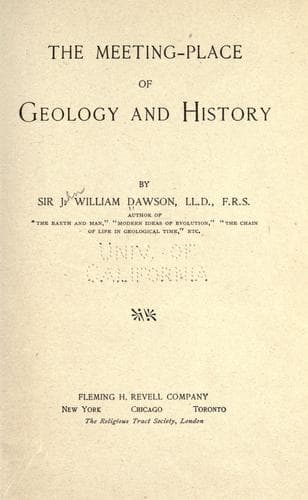
The Meeting-Place of Geology and HistoryDawson, John William, Sir
Religion
The Meeting-Place of Geology and History
Dawson, John William, Sir
Deluge; Prehistoric peoples
A later inroad was that of the Hittites, evidently a people having
affinity with the Philistines and Egyptians, but whose chiefs and nobles
seem to have been of Tartar blood, like the modern Turks. The names of
their kings seem also to have been non-Semitic. Later, the great
westward migration of Semitic peoples, to which that of Abraham himself
belongs, not only introduced the Israelites but many nations of Semitic
or mixed blood, the Moabites, Ammonites, Edomites, Ishmaelites, &c.,
whom we find figuring in the Egyptian monuments as yellow or brownish
people with a Jewish style of features, and all of whom, as mentioned
above, would be known to the Egyptians and Canaanites as 'Hebrews.'[83]
[83] This is independent of the question whether we regard the name Eber
as that of an ancestor, or merely of men from beyond the Euphrates.
Thus the monuments confirm the Jewish record, and the confusion which
some ethnologists have introduced into the matter arises from their
applying in an arbitrary manner the special tests of physical and
philological characteristics, and neglecting to distinguish the primary
migrations of men from subsequent intrusions.
Another singular point of agreement is that, just as in Egypt we find
men civilised from the first, so we find elsewhere. In Egypt writing and
literature date from before the time of Abraham. In like manner we have
no monumental evidence of any time when the Accadian people of Babylonia
were destitute of writing and science, and we now find that there were
learned scribes in all the cities of Canaan, and that the Phœnicians and
Southern Arabians knew their alphabet ages before Moses, while even the
Greeks seem to have known alphabetic writing long before the Mosaic
age.[84] These men, in short, were descendants of the survivors of the
Noachian Deluge, and therefore civilised from the first; and though we
have no certain evidence of letters before the Flood, except the
statement of the author of the Babylonian deluge tablets, that Noah hid
written archives at Sippara before going into the ark, yet it is quite
certain that men who could build Noah's ship are not unworthy ancestors
of the Phœnician seamen, who probably launched their barks on the
Mediterranean before the death of Noah himself. Thus, whatever value we
may attach to the record in Genesis, we cannot refuse to admit that it
is thoroughly consistent with itself and with the testimony of the
oldest monuments of Asia and Africa, as it is also with the evidence of
the geological changes of the pleistocene and early modern epoch.
[84] Petrie, _Illahun, Kahun and Garob_, 1891.
Public-domain text, read in full here on John Shaqi.
Reviews
Reviews
No reviews yet
Be the first to share your thoughts on this work.
Elsewhere in the archive
Join the Discussion
Join the discussion
Sign in to leave a comment or review.
Sign InorCreate an account