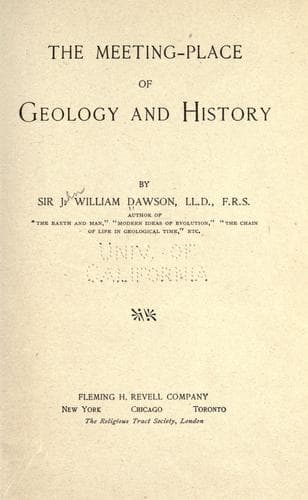
The Meeting-Place of Geology and HistoryDawson, John William, Sir
Religion
The Meeting-Place of Geology and History
Dawson, John William, Sir
Deluge; Prehistoric peoples
We thus learn that, relatively to Bible history, there is no prehistoric
age, since it carries us back beyond the Deluge to the origin of man, so
that we might properly restrict this term in its narrower signification
to those parts of the world not covered by this primitive history. It is
true that a tide of criticism hostile to the integrity of Genesis has
been rising for some years; but it seems to beat vainly against a solid
rock, and the ebb has now evidently set in. The battle of historical and
linguistic criticism may indeed rage for a time over the history and
date of the Mosaic law, but in so far as Genesis is concerned it has
been practically decided by scientific exploration.
Since writing the preceding pages I have met with a remarkable paper
by Mr. Horatio Hale in the _Transactions of the Royal Society of
Canada_.[88] It is one which should commend itself to the study of
every Biblical scholar and archæologist; but is contained in a
periodical which perhaps meets the eyes of few of them. In this paper
he maintains the importance of language as a ground of anthropological
classification, and then uses his wide knowledge of the languages of
American aborigines, and other rude races, to show that the grammatical
complexity and logical perfection of these languages implies a high
intellectual capacity in their original framers, and that where such
complex and perfect languages are spoken by very rude tribes like the
Australian aborigines, they originated with cultivated and intellectual
peoples--in the case of the Australian, with the civilised primitive
Dravidians of India. He thus shows that languages, like alphabets, have
undergone a process of degradation, so that those of modern times are
less perfect exponents of thought than those which preceded them, and
that primitive man in his earliest state must have been endowed with as
high intellectual powers as any of his descendants.
[88] Vol. IX. Sec. II. 1891.
Public-domain text, read in full here on John Shaqi.
Reviews
Reviews
No reviews yet
Be the first to share your thoughts on this work.
Elsewhere in the archive
Join the Discussion
Join the discussion
Sign in to leave a comment or review.
Sign InorCreate an account