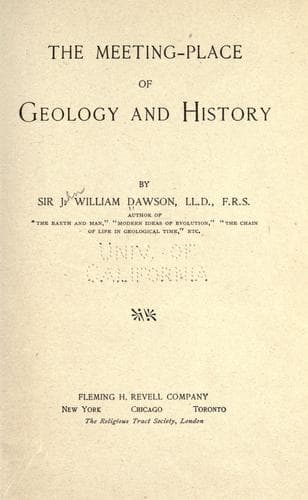
The Meeting-Place of Geology and HistoryDawson, John William, Sir
Religion
The Meeting-Place of Geology and History
Dawson, John William, Sir
Deluge; Prehistoric peoples
On similar grounds he shows that it is not in the outlying barbarous
races that we are to look for truly primitive man, since here we have
merely degraded types, and that the primitive centres of man and
language must have been in the old historic lands of Western Asia and
Northern Africa. On this view the time necessary for the development of
the arts of civilisation and of extensive colonisation would not be
great. 'In five centuries a single human pair planted in a fertile oasis
might have given origin to a people of five hundred thousand souls,
numerous enough to have sent out emigrations to the nearest inviting
lands.' The same lapse of time would have sufficed to develop
agriculture, to domesticate animals, and to make some progress in
architectural and other arts of life. He quotes the remarkable passage
of Reclus[89] as to the agency of woman in the inventions of early art,
and shows that this accords with more modern experience among the less
civilised nations. It is obvious that all this tends to bring scientific
anthropology into the closest relation with the old Biblical history,
though Hale, in deference, perhaps, to modern prejudices, does not refer
to this.
[89] _Primitive Folk_ (Contemporary Science Series), p. 58.
In the passage quoted by Hale, Reclus says: 'It is to woman that mankind
owes all that has made us men.' Following this hint of the ingenious
French writer, we may imagine the first man and woman inhabiting some
fertile region, rich in fruits and other natural products, and
subsisting at first on the uncultivated bounty of nature. With the birth
of their first child, perhaps before, would come the need of shelter
either in some dry cavern or booth of poles and leaves or bark, carpeted
perhaps with moss or boughs of pine. This would be the first 'home,'
with the woman for its housekeeper. We may imagine the man bringing to
it the lamb or kid whose dam he had killed, and the woman, with motherly
instinct, pitying the little orphan and training it to be a domestic
pet, the first of tamed animals. She, too, would store grain, seeds and
berries for domestic use, and some of these germinating would produce
patches of grain, or shrubs, or fruit trees around the hut. Noticing
these and protecting them, she would be the first gardener and
orchardist. The woman and her children might add to the cultivated
plants or domesticated quadrupeds and birds; and the man would be
induced, in the intervals of hunting and fishing, to guard, protect, and
fence them.
Public-domain text, read in full here on John Shaqi.
Reviews
Reviews
No reviews yet
Be the first to share your thoughts on this work.
Elsewhere in the archive
Join the Discussion
Join the discussion
Sign in to leave a comment or review.
Sign InorCreate an account