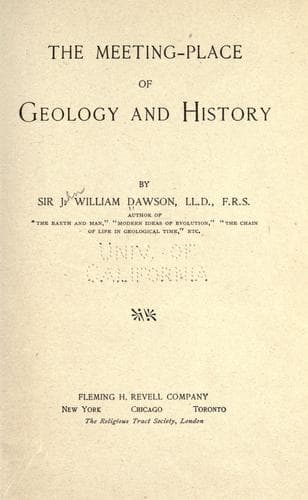
The Meeting-Place of Geology and History — John Shaqi
The Meeting-Place of Geology and HistoryDawson, John William, Sir
Religion
The Meeting-Place of Geology and History
Dawson, John William, Sir
Deluge; Prehistoric peoples
The former is a shelter or hollow under an over-*hanging ledge of
limestone, and excavated originally by the action of the weather on a
softer bed. It fronts the south-west, and, having originally been about
eight feet high and nearly twenty deep, must have formed a comfortable
shelter from rain or cold or summer sun, and with a pleasant outlook
from its front. Being nearly fifty feet wide, it was capacious enough to
accommodate several families, and when in use it no doubt had trees or
shrubs in front, and may have been further completed by stones, poles,
or bark placed across the opening. It seems, however, in the first
instance to have been used only at intervals, and to have been left
vacant for considerable portions of time. Perhaps it was visited only by
hunting or war-parties. But subsequently it was permanently occupied,
and this for so long a time that in some places a foot and a half of
ashes and carbonaceous matter, with bones, implements, &c., was
accumulated. All of these, it may be remarked, belong to the
palanthropic age. By this time the height of the cavern had been much
diminished, and, instead of clearing it out for future use, it was made
a place of burial, in which five individuals were interred. Of these,
three were men, one of great age, the other two probably in the prime of
life. The fourth and fifth were a woman of about thirty or forty years
of age, and the remains of a fœtus.
These bones, with others to be mentioned in connection with them,
unquestionably belong to some of the oldest human inhabitants known in
Western Europe. They have been most carefully examined by several
competent anatomists and archæologists, and the results have been
published with excellent figures in the _Reliquiæ Aquitanicæ_, where
will also be found details of their characters and accompaniments, among
which last were about three hundred small shells of different species
pierced for stringing or attachment to garments. These men are,
therefore, of the utmost interest for our present purpose, and I shall
try so to divest the descriptions of anatomical details as to give a
clear notion of their character. The doubts at one time cast on the age
of these skeletons have been removed by the discovery of others at
Laugerie Basse, Mentone, &c. They are no doubt palanthropic, though not
of the earliest part of the period. The 'Old Man of Cro-magnon' was of
great stature, being nearly six feet high. More than this, his bones
show that he was of the strongest and most athletic muscular
development; and the bones of the limbs have the peculiar form which is
characteristic of athletic men habituated to rough walking, climbing,
and running; for this is, I believe, the real meaning of the enormous
strength of the thigh-bone and the flattened condition of the leg in
this and other old skeletons. It occurs to some extent, though much less
than in this old man, in American skeletons. His skull presents all the
Public-domain text, read in full here on John Shaqi.
Reviews
Reviews
No reviews yet
Be the first to share your thoughts on this work.
Join the Discussion
Join the discussion
Sign in to leave a comment or review.
Sign InorCreate an account