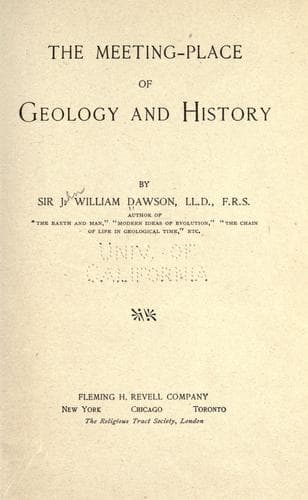
The Meeting-Place of Geology and HistoryDawson, John William, Sir
Religion
The Meeting-Place of Geology and History
Dawson, John William, Sir
Deluge; Prehistoric peoples
And now let us pause for a moment to picture these so-called palæolithic
men. What could the 'Old Man of Cro-magnon' have told us, had we
been able to sit by his hearth and listen understandingly to his
speech?--which, if we may judge from the form of his palate-bones, must
have resembled more that of the Americans or Mongolians than of any
modern European people. He had, no doubt, travelled far, for to his
stalwart limbs a long journey through forests and over plains and
mountains would be a mere pastime. He may have bestridden the wild
horse, which seems to have abounded at the time in France, and he may
have launched his canoe on the waters of the Atlantic. His experience
and memory might extend back a century or more, and his traditional lore
might go back to the times of the first mother of our race. Did he live
in that wide post-pliocene continent which extended westward through
Ireland? Did he know and had he visited the more cultured nations that
lived in the great plains of the Mediterranean Valley, or on that
nameless river which flowed through the land now covered by the German
Ocean? Had he visited or seen from afar the great island Atlantis, whose
inhabitants could almost see in the sunset sky the islands of the blest?
Could he have told us of the huge animals of the antediluvian world, and
of the feats of the men of renown who contended with these animal
giants? We can but conjecture all this. But, mute though they may be as
to the details of their lives, the man of Cro-magnon and his
contemporaries are eloquent of one great truth, in which they coincide
with the Americans and with the primitive men of all the early ages.
They tell us that primitive man had the same high cerebral organisation
which he possesses now, and, we may infer, the same high intellectual
and moral nature, fitting him for communion with God and headship over
the lower world. They indicate also, like the mound-builders, who
preceded the North American Indian, that man's earlier state was the
best--that he had been a high and noble creature before he became a
savage. It is not conceivable that their high development of brain and
mind could have spontaneously engrafted itself on a mere brutal and
savage life. These gifts must be remnants of a noble organisation
degraded by moral evil. They thus justify the tradition of a Golden and
Edenic Age, and mutely protest against the philosophy of progressive
development as applied to man, while they bear witness to the
similarity in all important characters of the oldest prehistoric men
with that variety of our species which is at the present day at once the
most widely extended and the most primitive in its manners and
usages.[19]
Public-domain text, read in full here on John Shaqi.
Reviews
Reviews
No reviews yet
Be the first to share your thoughts on this work.
Join the Discussion
Join the discussion
Sign in to leave a comment or review.
Sign InorCreate an account