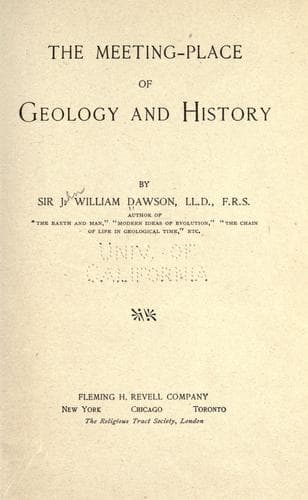
The Meeting-Place of Geology and HistoryDawson, John William, Sir
Religion
The Meeting-Place of Geology and History
Dawson, John William, Sir
Deluge; Prehistoric peoples
On the subject of the correlation of the French and Belgian discoveries
as to primitive man, a most interesting and important communication was
made by Dupont to the Geological Society of Belgium in 1892.[21] The
veteran explorer of the Belgian caves addresses himself in this paper to
a careful comparison of the geological relations, animal remains and
human relics in these caves, and in the gravels and 'quaternary' clays
associated with them. He arrives at the conclusion, which I had already
stated,[22] that these deposits are contemporaneous and show similar
stages, but that the mammoth age properly so-called, in which the
primitive people fed on the mammoth and its companion the woolly
rhinoceros, extended to a later date in Belgium than in France, so that
the mammoth age of Dupont and the reindeer age of the French
archæologists overlap one another. He notes in connection with this that
there is evidence of the continued existence of the mammoth in the
so-called reindeer age of France, in the discovery in caves of that
period of plates of ivory with the portrait of the mammoth engraved on
them. It would therefore appear either that the mammoth earlier became
extinct or rare in France, perhaps on account of climatal changes, or
perhaps because of destruction by man, or that the habits of the French
populations changed in such a way as to cause them to confine themselves
to smaller game. In either case, we now find that the whole palanthropic
age is one period. On the other hand, Dupont agrees with Mortillet that
there is a hiatus, physical, palæontological and anthropological,
between the so-called palæolithic and neolithic periods, that is,
between the palanthropic and neanthropic ages.
[21] _Bulletin de la Société Belge de Géologie_, janvier 1893. This
paper should be studied by all interested in the subject.
[22] _Fossil Men._
Dupont holds that the plain-dwellers (_Pedionomytes_, as he calls them)
were the earliest known men, corresponding to the oldest gravel remains
of Dawkins and Prestwich, and points out that their implements are in
size and form, though not in material and finish, allied to those of the
polished stone age, which might thus be regarded as an improved
continuation or revival of this first period. This might be read to
mean, as above maintained, that the earliest men were peaceful and
perhaps in part agricultural, that they were succeeded by lawless,
powerful, artistic and savage peoples, and when the latter were swept
away that a remnant of the primitive stock repossessed the land. If this
proves to be the net result, it will correspond exactly with our old
historical beliefs.
Public-domain text, read in full here on John Shaqi.
Reviews
Reviews
No reviews yet
Be the first to share your thoughts on this work.
Join the Discussion
Join the discussion
Sign in to leave a comment or review.
Sign InorCreate an account