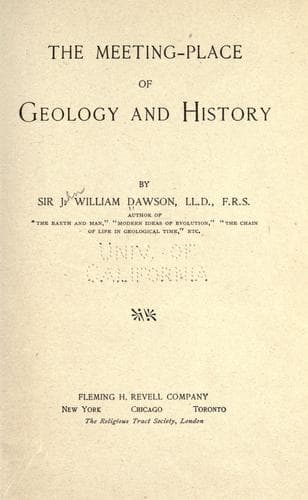
The Meeting-Place of Geology and HistoryDawson, John William, Sir
Religion
The Meeting-Place of Geology and History
Dawson, John William, Sir
Deluge; Prehistoric peoples
Thus we seem shut up to the conclusion that the close of the
palanthropic age was marked by great geological vicissitudes of the
character of submergence, leading primarily to vast destruction of
animal life, and secondarily to permanent changes both in geography and
climate, under which new conditions the neanthropic age was inaugurated.
How this took place we have to inquire in the sequel. In the meantime we
may merely remark that since the two principal races of primitive men
known to us in Europe seem to have perished, we must infer that
individuals of a third race beyond the limits of Europe were destined to
survive, and again to replenish the earth in the new era, and that
possibly these may be represented by the solitary Truchère skull. In the
case of many of the more bulky and unwieldy animals inhabiting the
plains the case was different. They perished, or if any survived the
submergence they were unable to multiply under the new conditions.
Desperate attempts have been made in the interests of extreme
uniformitarianism to discredit the abrupt change from palæocosmic to
neocosmic men. It has been supposed that the latter replaced the former
as conquerors--a most unlikely theory, when their relative powers are
considered. It has been conjectured that as the cold decreased the old
races of men followed the reindeer to the north and became Arctic
peoples. But why did they not rather attack the new animals, which in
that case must have come in from the south? It has even been supposed
that the Esquimaux may be their descendants; but they are quite
different in physical characters, and have no nearer resemblance in
their arts than other rude peoples. In opposition to all this we have
not only the remarkable change in the races of men and in their animal
associates, but when we know that the whole geographical features of our
continents have changed since the palanthropic age, and that not only
are our continents reduced in size since the continental post-glacial
period, but that there is evidence of re-elevation as well as
subsidence, and this within a short period--say eight thousand years
less the historic period on the one hand and the early palanthropic on
the other--it seems impossible to doubt the greatness and suddenness of
the physical break that divides the anthropic age into two distinct
portions. All this may be held to be certainly known as geological fact,
and it would be folly to overlook it in any discussions as to primitive
man, or in any comparisons of the evidence afforded by his remains with
that of early human history or tradition.
Public-domain text, read in full here on John Shaqi.
Reviews
Reviews
No reviews yet
Be the first to share your thoughts on this work.
Elsewhere in the archive
Join the Discussion
Join the discussion
Sign in to leave a comment or review.
Sign InorCreate an account