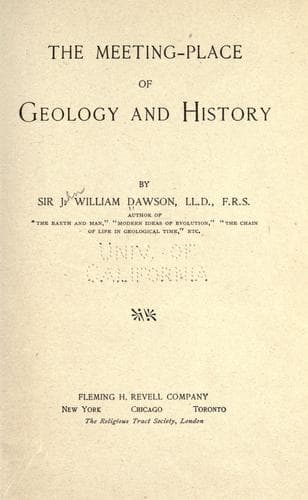
The Meeting-Place of Geology and HistoryDawson, John William, Sir
Religion
The Meeting-Place of Geology and History
Dawson, John William, Sir
Deluge; Prehistoric peoples
When we leave the Deluge and come to the postdiluvian or neanthropic
period, similar coincidences occur. The foundation of a primitive
Cushite or Akkadian kingdom in the Euphratean valley, the dispersion of
men according to their families and their languages, the early kingdoms
contemporary with Abraham, mentioned in the narrative of his campaign to
recover the captives taken from the cities of the plain, the extremely
early use of the arrow-headed characters in Asia, of the hieroglyphic
writing in Egypt, and of a proto-Phœnician or early Hebrew alphabet
among the Mineans of ancient Arabia, tend at once to vindicate the Bible
history, and to show how at a very early period this history may have
been rendered permanent in written documents. On all these grounds
scientific archæologists are beginning to attach more value than
formerly to the Hebrew annals, and to recognise them as true historical
accounts of the times to which they relate.
It may seem rash to make such a statement at a time when it is well
known that many divines of repute avow themselves as believers in the
theory that the earlier Biblical books are of comparatively late
composition. But Science will have her way in a matter of this kind,
whatever literature or criticism may say, and she is beginning strongly
to lift her voice against the destructive criticism of the Pentateuch.
In a recent article, Professor Sayce, one of the best-informed experts
in these subjects, uses the following language:
'Naturally, the "higher criticism" is disinclined to see its assumptions
swept away along with the conclusions which are based upon them, and to
sit humbly at the feet of the newer science. At first, the results of
Egyptian or Assyrian research were ignored; then they were reluctantly
admitted, so far as they did not clash with the preconceived opinions of
the "higher" critics. It was urged, unfortunately with too much justice,
that the decipherers were not, as a rule, trained critics, and that in
the enthusiasm of research they often announced discoveries which proved
to be false or only partially correct. But it must be remembered, on the
other side, that this charge applies with equal force to all progressive
studies, not excluding the "higher criticism" itself.
'The time is now come for confronting the conclusions of the "higher
criticism," so far as it applies to the books of the Old Testament, with
the ascertained results of modern Oriental research. The amount of
certain knowledge now possessed by the Egyptologist and Assyriologist
would be surprising to those who are not specialists in these branches
of study, while the discovery of the Tel-el-Amarna tablets has poured a
flood of light upon the ancient world, which is at once startling and
revolutionary. As in the case of Greek history, so too in that of
Israelitish history, the period of critical demolition is at an end, and
it is time for the archæologist to reconstruct the fallen edifice.
Public-domain text, read in full here on John Shaqi.
Reviews
Reviews
No reviews yet
Be the first to share your thoughts on this work.
Elsewhere in the archive
Join the Discussion
Join the discussion
Sign in to leave a comment or review.
Sign InorCreate an account