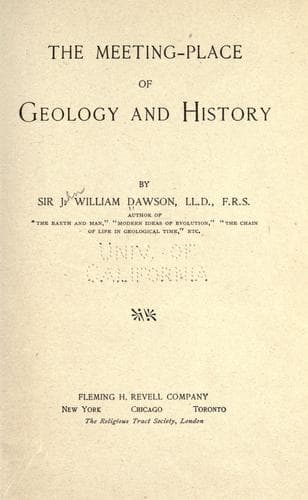
The Meeting-Place of Geology and HistoryDawson, John William, Sir
Religion
The Meeting-Place of Geology and History
Dawson, John William, Sir
Deluge; Prehistoric peoples
1. The recent discovery of the Chaldean deluge tablets has again
directed attention to the statements of Berosus respecting the
Babylonian tradition of a great flood, and these statements are found to
be borne out in the main by the contents of the tablets. There is thus a
twofold testimony as to the occurrence of a deluge in that Babylonian
plain which the Old Testament history represents as the earliest seat of
antediluvian man. As Lenormant has well shown, the tradition exists in
the ancient literature of India, Persia, Phœnicia, Phrygia, and Greece,
and can be recognised in the traditions of Northern and Western Europe
and of America, while the Egyptians had a similar account of the
destruction of men, but apparently not by water, though their idea
of a submerged continent of Atlantis probably had reference to the
antediluvian world. Thus we find this story widely spread over the
earth, and possessed by members of all the leading divisions of mankind.
This does not necessarily prove the universality of the Deluge, though
every distinct people naturally refers it to its own country. It shows,
however, the existence of some very early common source of the tradition,
and the variations are not more than were to have been expected in the
different of transmission.
2. Parallel with this historical evidence lies the result of geological
and archæological research, which has revealed to us the remains and
works of prehistoric men, racially distinct from those of modern times,
and who inhabited the earth at a period when its animal population was
to a great extent distinct from that at present existing, and when its
physical condition was also in many respects different. Thus in Europe
and Asia, and to some extent also in America, we have evidence that the
present races of men were preceded by others which have passed away, and
this at the same time with many important species of land animals, once
the contemporaries of man, but now known only as fossils. These ancient
men are those called by geologists later pleistocene, or post-glacial,
or the men of the cave and gravel deposits, or of the age of the
mammoth, and who have been designated by archæologists palæolithic men,
or, more properly, palæocosmic men, since the character of their stone
implements is only one not very important feature of their history, and
implements of the palæolithic type have been used in all periods, and
indeed are still used in some places.
Public-domain text, read in full here on John Shaqi.
Reviews
Reviews
No reviews yet
Be the first to share your thoughts on this work.
Elsewhere in the archive
Join the Discussion
Join the discussion
Sign in to leave a comment or review.
Sign InorCreate an account