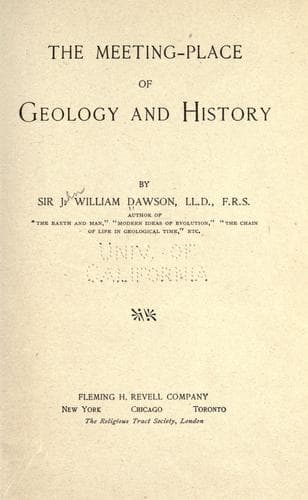
The Meeting-Place of Geology and HistoryDawson, John William, Sir
Religion
The Meeting-Place of Geology and History
Dawson, John William, Sir
Deluge; Prehistoric peoples
3. The prevalence among geologists of an exaggerated and unreasonable
uniformitarianism, which refused to allow sufficient prominence to
sudden cataclysms arising from the slow accumulation of natural forces,
and which was a natural reaction from the convulsive geology of an
earlier period, has caused the idea to be generally entertained that the
age of palæocosmic men was of vast duration, and passed only by slow
gradations and a gradual transition into the new conditions of the
modern period. This view long was, and still is, an obstacle to any
rational correlation of the geological and traditional history of man.
Recently, however, new views have been forced on geologists, and have
led many of the most sagacious observers and reasoners to see that the
palanthropic period is much nearer to us than we had imagined. The
arguments for this I have referred to in previous pages, and need not
reiterate them, here. A few leading points may, however, be noted. One
of these is the small amount of physical or organic change which has
occurred since the close of the palanthropic period. Another is the more
rapid rate of erosion and deposition by rivers in the modern period than
had previously been supposed. Another is the striking fact that a large
number of mammals, like the mammoth and woolly rhinoceros, seem to have
perished simultaneously with the palæocosmic men, and this by some
sudden catastrophe.[41] It has also been shown by Pictet and Dawkins
that all the extant mammals of Europe already existed in the
post-glacial age, but along with many others now altogether or locally
extinct. Thus there seems to have been the removal over the whole
northern hemisphere of a number of the largest mammals, while a selected
number survived and no additions were made. Again, while at one time it
was supposed that the remains of palæocosmic man and his contemporaries
were confined to caverns and river alluvia, it is now known that they
occur also on high plateaus and water-sheds, in beds of gravel and silt
which must have been deposited there under conditions of submergence and
somewhat active current drift, perhaps in some cases aided by floating
ice.[42] Lastly, while, as must naturally be the case, in some places
the remains of ancient and more modern men are mixed, or seem to pass
into each other, in others, as in the Swiss, Belgian and Lebanon caves
and in the superficial deposits, there is a distinct separation,
implying an interval accompanied by physical change between the time of
the earlier and later men.
[41] Howorth, _The Mammoth and the Flood_.
[42] Prestwich on deposits at Ightham, Kent, _Journal Geological
Society_, May 1889.
Public-domain text, read in full here on John Shaqi.
Reviews
Reviews
No reviews yet
Be the first to share your thoughts on this work.
Elsewhere in the archive
Join the Discussion
Join the discussion
Sign in to leave a comment or review.
Sign InorCreate an account